AXI4-Lite explained: handshakes, writes, reads, errors and state machines
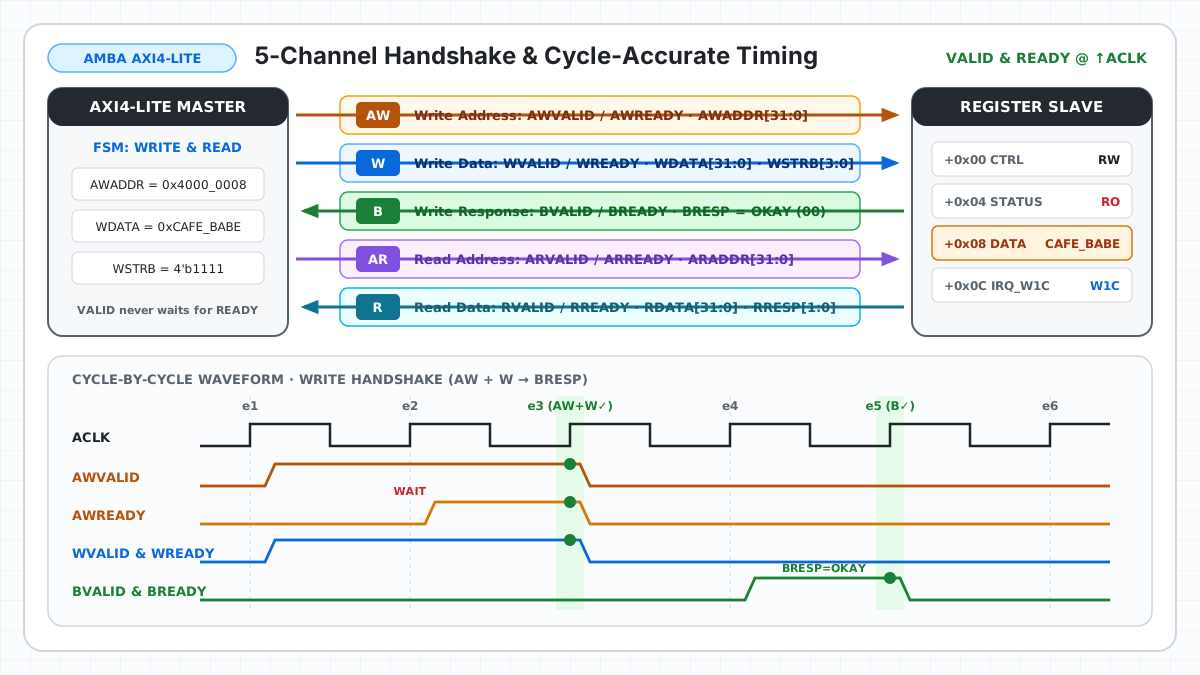
An interactive guide for people who have never used AXI. Each step loads a scenario into a small cycle-accurate simulator of one master and one register slave. Move through the clock edges and watch the five channels, the waveform, the state machines on both sides and the registers. The playground lets you change every delay and build your own transactions, including ones that break the rules.
AXI4-Lite Explained: VALID / READY Handshakes, Write and Read Channels, Byte Strobes, Error Responses and State Machines
Learn the AMBA AXI4-Lite protocol cycle by cycle with an interactive simulator of one master and one register slave: the five channels AW, W, B, AR and R, the VALID / READY handshake, wait states and back-pressure, address before data and data before address, WSTRB byte strobes, write-1-to-clear registers, BRESP and RRESP responses OKAY, SLVERR and DECERR, read latency, read / write ordering, back-to-back transactions, the AWREADY / WVALID deadlock, illegal VALID withdrawal, ARESETn reset behaviour and a full playground.