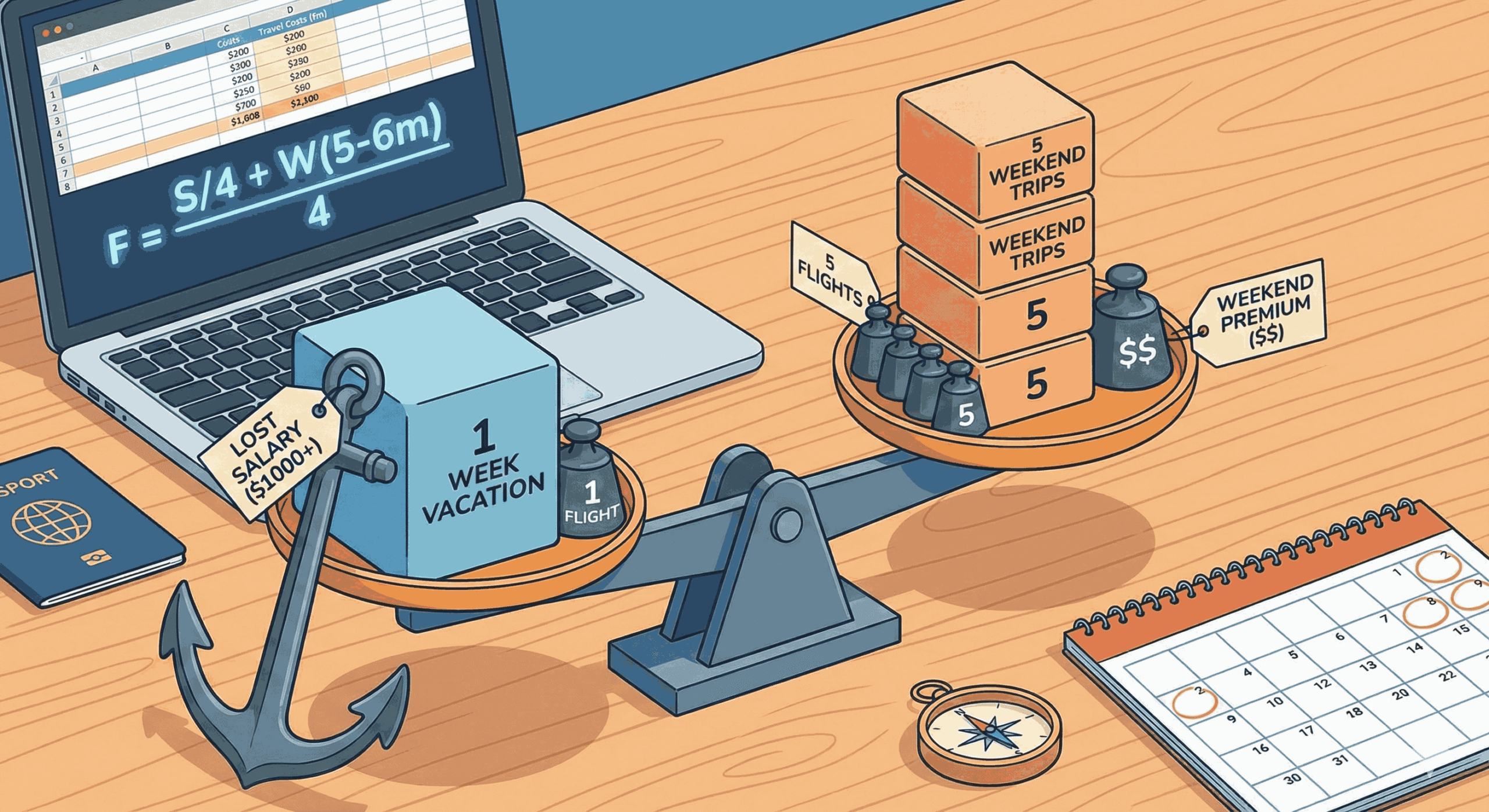
If you search for “how to save money on travel,” the first result is always the same: Fly mid-week. The logic seems sound. Flights on Tuesdays are cheaper than flights on Fridays. Hotels on Wednesdays are cheaper than hotels on Saturdays. Therefore, traveling mid-week saves you money.
But this advice ignores the single most expensive variable in your life: Your Salary.
Most standard travel guides assume your time is free. They treat “vacation days” as a sunk cost. But for freelancers, contractors, or anyone negotiating unpaid leave to extend their travels, a Tuesday flight isn’t just a \$75 ticket—it is a \$75 ticket plus a day of lost income.
Here is the advanced mathematical hack that budget blogs ignore: The Vacation Buy-Back Formula.
The Hidden Cost of “Buying” Time
Let’s look at the trade-off. You have two options to get roughly 10 days of travel time:
- The Standard Vacation: You take a week off unpaid. You get 9 consecutive days. You buy 1 flight. You lose 1 week of salary.
- The Weekend Warrior: You travel for 5 separate weekends. You get 10 days. You buy 5 flights. You lose \$0 salary.
The “Weekend Warrior” strategy feels more expensive because you see the credit card charges for 5 flights and peak-pricing hotels. But the “Standard Vacation” strategy quietly drains your bank account by removing income you would have otherwise earned.
The Big Assumptions (And Why It Still Works)
Let’s be honest: this mathematical framework relies on a couple of assumptions.
First, it assumes that if you stayed home, you wouldn’t be doing much on the weekend anyway—essentially just “wasting” your time. Second, it assumes the hours spent in transit (like sitting on a plane or train) are lost time that you wouldn’t use otherwise.
In reality, we know that isn’t always true. You can absolutely bring your laptop on a flight and use that transit time productively to work, plan, or learn.
But even with those nuances, this calculation is a fascinating thought experiment. If you frequently reach Sunday evening feeling like you didn’t do much with your weekend, yet you constantly wish you could travel more, this strategy is built perfectly for you.
The Formula
Stop guessing. Here is the exact formula to calculate your Break-Even Flight Price ($F$).
If you can find return flights for less than $F$, it is mathematically cheaper to pay the weekend premium than to take the week off work.
The Variables
- $S$ = Your Monthly Net Salary.
- $W$ = Your “Base” Daily Living Cost (what you spend on a normal day).
- $m$ = The Weekend Multiplier (e.g., 1.5 if weekends cost 50% more than weekdays, or 2.0 if they double in price).
The Equation
$$F = \frac{\frac{S}{4} + W(5 – 6m)}{4}$$
A Real-World Example
Let’s assume you earn \$4,000/month ($S$). On a normal day at home or traveling mid-week, you spend \$75 ($W$). On weekends, prices surge, so your living costs are 50% higher ($m = 1.5$).
$$F = \frac{1000 + 75(5 – 6(1.5))}{4}$$
$$F = \frac{1000 + 75(5 – 9)}{4}$$
$$F = \frac{1000 + 75(-4)}{4}$$
$$F = \frac{1000 – 300}{4}$$
$$F = \textbf{175}$$
The Verdict
If you can find a flight for \$175 or less, ignore the “fly on Tuesday” advice.
Book the Friday night flight. Pay the 50% hotel markup. You are still coming out financially ahead because you protected your income.
Who Is This For?
This hack isn’t for the slow traveler who wants to lounge in a single city for a month. This is for the efficient explorer.
If your goal is to maximize your trips, break out of your weekend routine, and explore more destinations without decimating your yearly earnings, this formula is your permission slip to travel on Saturdays and Sundays.
Don’t let “budget” advice trick you into valuing your time at zero. Run the numbers, pack your laptop if you need to, book the weekend, and keep your salary.