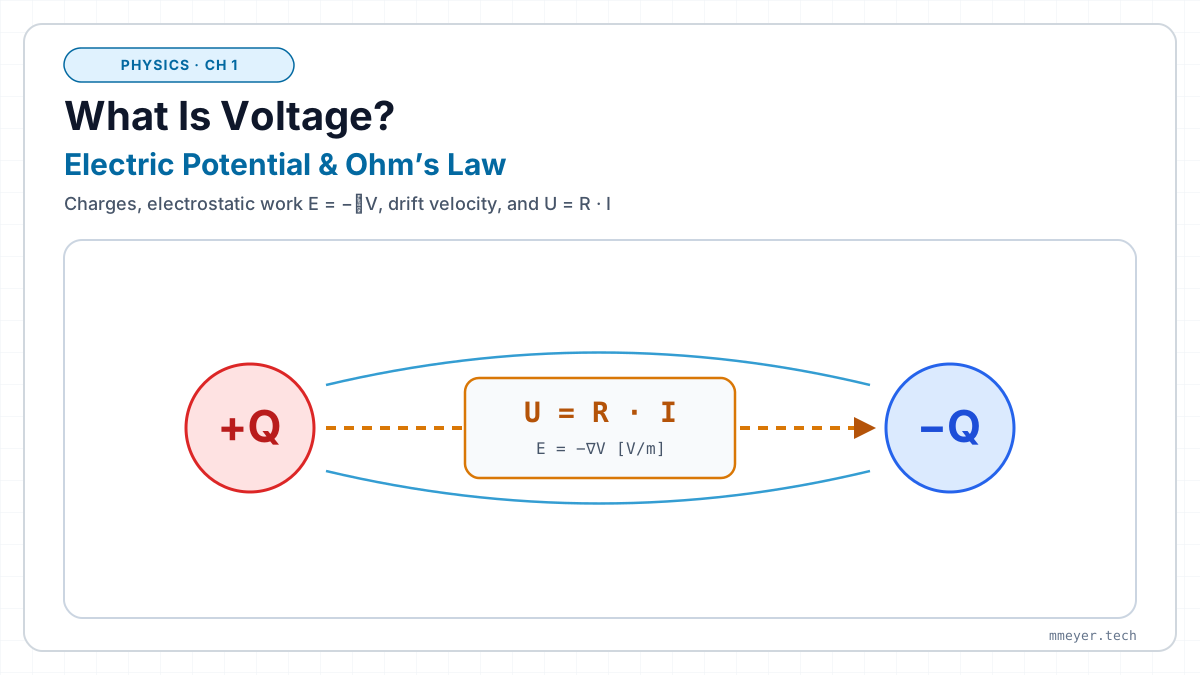
What voltage really is, and where U = R·I comes from
This page builds voltage up from scratch: a force on a charge, the work it takes to move that charge, and a landscape of potential. Then it derives Ohm's law twice, once from electrons bouncing through a metal and once from Maxwell's equations. Every picture is live. Go through it in order to explain it to someone else. It is the starting point of the learning path and works together with Chapter 2 (Maxwell's equations) and Chapter 3 (matter and magnets). Later, Chapter 4: where the current flows in a plate, with variational principles.
Charges push and pull. The field is the push per charge.
Everything electric starts with charge. Like charges repel and opposite charges attract, with a force that falls off with the square of the distance (Coulomb's law):
Divide by the small test charge q and you get something that belongs to the place, not to the test charge: the electric field , measured in V/m (= N/C). Drag both charges. Then flip the test charge: the force flips, but the field stays the same.
Moving a charge against the field costs work, and voltage measures it
Push a positive charge against the field and you do work, exactly like lifting a stone against gravity. The work per charge is the difference in potential φ. The voltage UAB is the potential difference between A and B:
1 V = 1 J/C: moving 1 coulomb up through 1 volt costs 1 joule. Drag the charge +q from A to B along any path you like. The meter adds up step by step along the path you actually drew.
Try several paths from A to B: the work always comes out the same. Bring the charge back to A along any loop and the total is zero. That is why every point can be given one number, its potential φ. In a uniform field, between plates a distance d apart, it is simply .
Potential is height, voltage is a difference in height, and the field points downhill
Since the work depends only on start and end, every point gets a "height" φ in volts: the potential energy that +1 C would have there. Voltage is a difference in height. The field points straight downhill, along the steepest slope:
The dark lines are equipotential lines, the contour lines of this landscape. E crosses them at right angles, and where they crowd together the field is strong. Click the map to drop marbles: positive charges roll downhill. Electrons are negative and roll "uphill". Drag the charges and the markers A and B.
Walk once around a circuit and you end up back at the same height
Faraday's law (Chapter 2, section 9) says . If no magnetic flux through the loop changes, the right side is zero:
This is Kirchhoff's voltage law. The battery lifts the charges up, the resistors let them back down, and the drops add up exactly to the lift. Click a node to put the red probe of a voltmeter there, then click another node for the black probe.
A battery is a charge pump, and water helps to picture it
In the wire, positive charge "rolls downhill" from + to −. Something has to carry it back up again. Inside the battery a chemical reaction does exactly that, pushing charge against the electric field. The work per charge that the battery can do is its electromotive force (EMF), equal to the voltage you measure without load.
| Water circuit | Electric circuit |
|---|---|
| pump | battery (EMF) |
| pressure, or height of the water | potential φ |
| pressure difference | voltage U |
| flow rate (litres per second) | current I (coulombs per second = A) |
| narrow pipe | resistor |
| the water fills the whole pipe | the electrons fill the whole wire |
Where the picture breaks: in a wire the push is not passed on by water pressure but by the electric field. Within nanoseconds of switching on, tiny surface charges on the wire set up a field that guides the current along every bend. The electrons themselves only crawl (next section).
Current is charge per time, and the electrons crawl
In copper, about one electron per atom is free to move: n ≈ 8.5·10²⁸ per m³. They whizz around at about 10⁶ m/s in random directions. The drift that makes up the current is tiny. Try it:
So why does the lamp light up the moment you flip the switch? The wire is already full of electrons. The push (the field) spreads at a good fraction of the speed of light and starts all of them moving at once, like water in a hose that is already full.
Accelerate, collide, forget, repeat: where Ohm's law comes from
A free electron in a field E is accelerated: . If nothing stopped it, the current would grow forever. In a normal metal the electron scatters off lattice vibrations and defects about every τ ≈ 25 fs and forgets its direction. On average it keeps only the velocity gained since its last collision:
This is Ohm's law in its local form. The drift is proportional to the field, so the current density is too. For copper: σ = 8.5·10²⁸ · (1.6·10⁻¹⁹)² · 2.5·10⁻¹⁴ / 9.1·10⁻³¹ ≈ 6·10⁷ S/m, which matches the measured value.
The electrons drift against E because they are negative, so the current points along E. Heat the metal and the lattice shakes harder: collisions come more often, τ gets shorter, and σ drops. That is why metals conduct worse when hot (copper: about +0.4 % resistance per kelvin). In the simulation the drift is exaggerated about 10¹⁰ times. In real copper it is a few millionths of a millimetre per collision.
Four steps from the field equations to Ohm's law
In a steady state, charge cannot accumulate anywhere: ∂ρ/∂t = 0. The divergence of the Ampère–Maxwell law gives
so the same current I flows through every cross-section (Kirchhoff's current law).
No changing B, so Faraday gives ∇×E = 0 and
The voltage along the wire is .
Electrons drift in proportion to the field (section 7):
A material law, not a law of nature.
Uniform wire of length L and cross-section A: E = U/L, J = I/A, so
Why are U and I proportional at all? Because every equation in this chain is linear. Double the voltage and E doubles everywhere, so J doubles everywhere, so I doubles. For any shape, is a single number fixed by geometry and material. Chapter 4 computes it for a whole plate.
The same current flows in all three segments (∇·J = 0). The current density, and with it the drift speed of the dots, is highest where the wire is thin. The voltage drops mostly across the worst conductor. Resistors in series simply add: R = R₁ + R₂ + R₃.
P = U·I, and the energy reaches the resistor through the space around the wire
Every charge that falls through the voltage U hands the energy qU to the lattice as heat, so the power is U·I. Maxwell's equations also say how this energy travels. The energy flux density is the Poynting vector . Around a resistor, E points along the wire and H circles around it, so S points radially inward. Integrate over the surface of the resistor: E·L = U and H·2πa = I give exactly P = U·I. The energy flows from the battery through the field around the wires into the resistor, not along the inside of the copper.
Ohm's law is a material property, not a law of nature
- Lamp filament: it gets hot, τ gets shorter, and R rises. The curve bends down. R = U/I still exists, but it is no longer a constant.
- Diode: the current grows exponentially. The number of carriers changes with the voltage.
- Superconductor: no collisions that destroy the current, so σ → ∞ and R = 0 below a critical temperature.
- High frequency: Faraday is back. U = R·I + L·dI/dt, and the skin effect pushes the current to the surface.
- Very strong fields: breakdown, sparks, arcs.
The dashed line from the origin gives the static resistance U/I. The dotted tangent gives the differential resistance dU/dI. For an ohmic resistor the two are equal.
The whole chain on one line
Explain it in two minutes
- Charges create a field: a force per charge at every point.
- Moving a charge against the field costs energy. Voltage is that energy per charge, measured in J/C = V.
- Because the static field has no swirl, this energy depends only on start and end, so every point has a "height" φ.
- A battery pumps charges up in height. In the wire they flow back down, and in a steady state the same current flows everywhere.
- In a metal, electrons are accelerated and keep colliding. Their drift is proportional to the field: J = σE.
- Integrate over a wire: U = (L/σA)·I = R·I. The heat is P = U·I, and the energy arrives through the field around the wire.