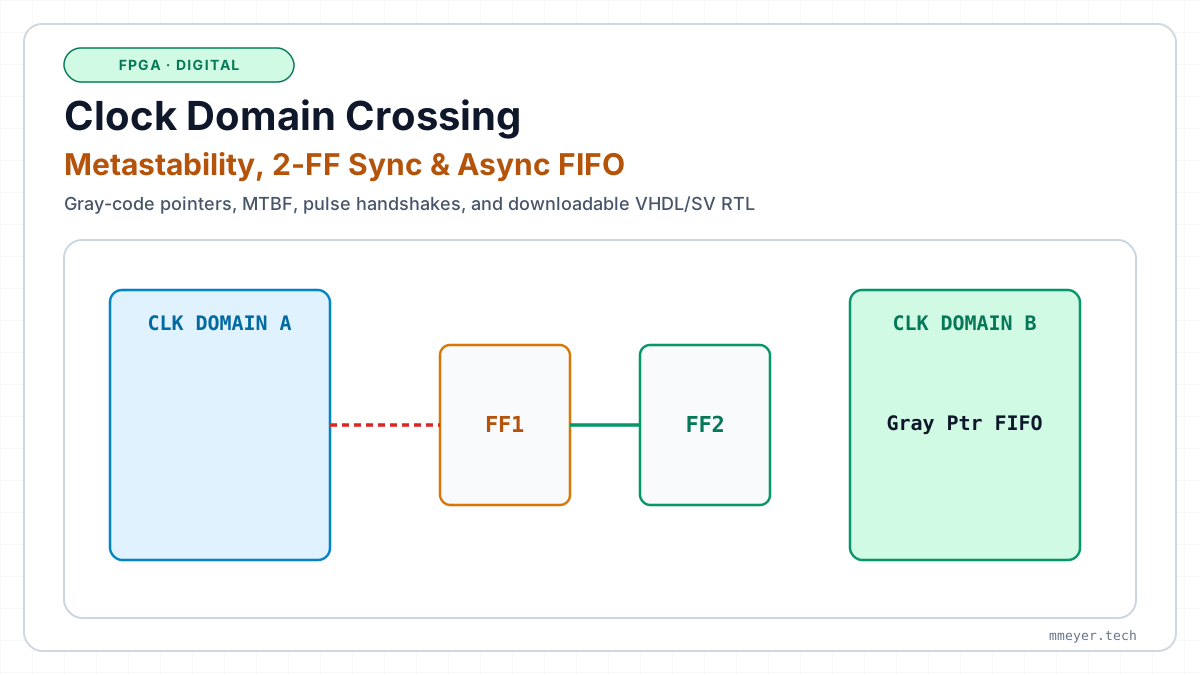
Clock domain crossing explained: metastability, synchronizers, Gray code, handshakes and asynchronous FIFOs
An interactive guide to moving signals safely between unrelated clocks in an FPGA. Each step loads a circuit into a small two-clock simulator that models setup/hold windows, metastable flip-flops, wire skew and asynchronous resets. Step edge by edge, watch flops go metastable and resolve, and see which method survives which situation. Every method comes with synthesizable VHDL and SystemVerilog, checked in real simulators, and with the timing constraints that belong to it.
Clock Domain Crossing Explained: Metastability, 2-FF Synchronizers, Gray Code and Async FIFOs
Trace asynchronous clock domain crossings edge by edge: setup/hold window violations, metastable settling and MTBF, 2-FF bit synchronizers, pulse/toggle handshakes, multi-bit bus skew vs Gray-coded async FIFOs, reset synchronization, and downloadable VHDL, SystemVerilog, XDC, and SDC RTL files.