Search any budget travel forum or social media feed for advice on cheap flights, and you will hear the exact same rule repeated like gospel: book and fly on Tuesdays. The conventional wisdom sounds convincing. Airlines supposedly release discounted seats early in the week, business travelers pack Monday and Friday flights, and leisure crowds swell on Saturdays. Therefore, budget travelers are told to plan their vacations strictly around midweek departures.
Yet for anyone taking unpaid leave, managing freelance client contracts, or valuing the financial worth of their billable hours, this universal recommendation contains a severe mathematical blindspot: it treats your working time as zero cost.
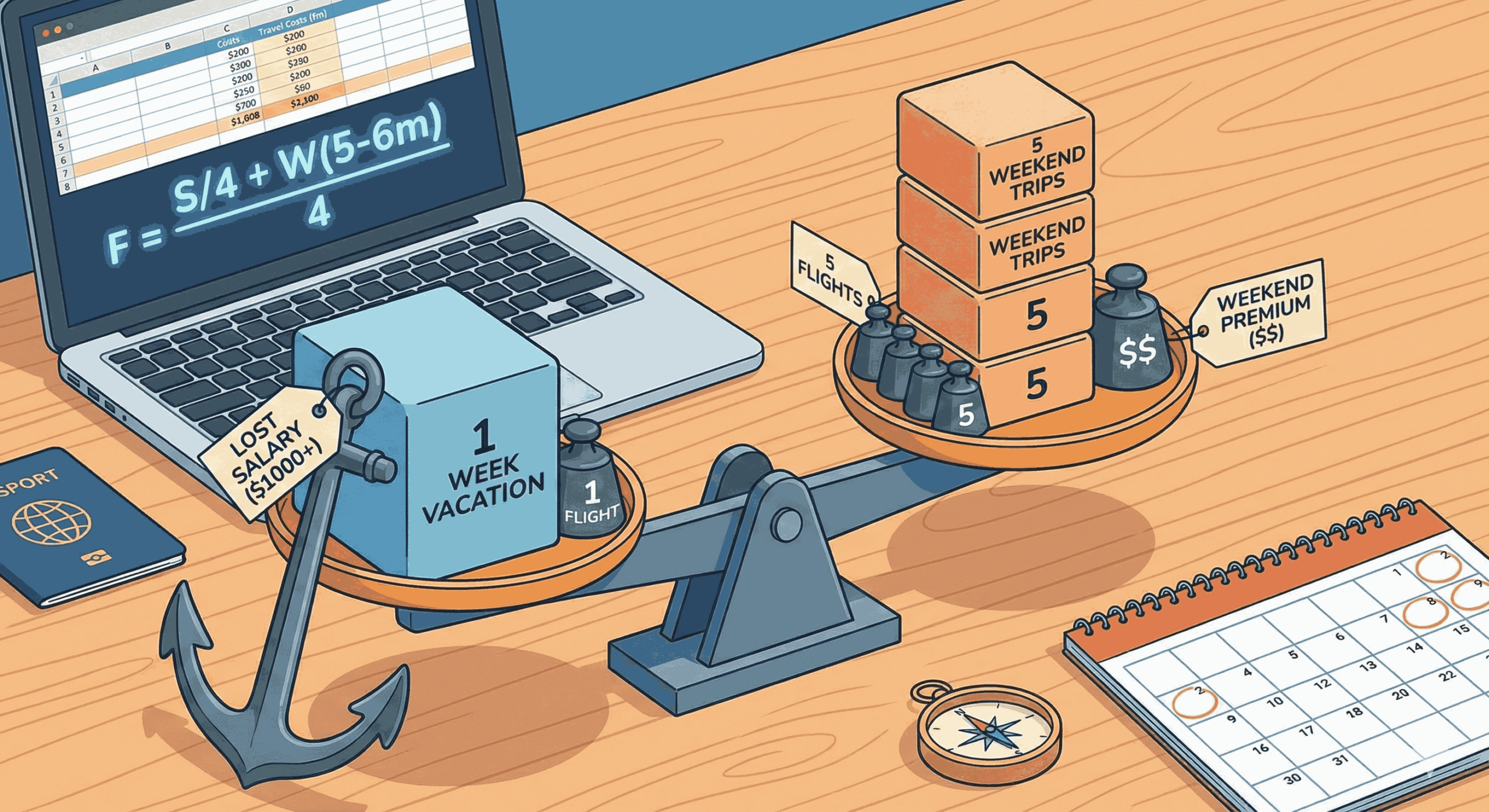
Saving sixty dollars on a Tuesday ticket while forfeiting a full day of professional earnings is not saving money. It is spending hundreds of dollars to buy a slightly cheaper airline seat. Here is an analytical breakdown of how airline pricing algorithms actually function, and the vacation buy back formula that reveals when paying weekend flight premiums is mathematically superior.
THE AIRLINE TUESDAY MYTH AND HOW MODERN FARES WORK
The belief that Tuesday is the magic day to purchase airline tickets is an obsolete remnant of airline distribution architecture from the 1990s. In that era, airline fare coordinators manually loaded revised discount fare sheets into central reservation systems on Monday evenings. Competing carriers reviewed those filings and manually matched discounts by Tuesday morning, creating a brief window of synchronized fare sales.
Modern commercial aviation operates on an entirely different computational plane. Modern revenue management software adjusts prices dynamically twenty four hours a day using automated yield management models, Poisson booking arrival distributions, and price elasticity segmentation.
Aggregated booking datasets across billions of flight queries show that the day of the week you click purchase varies the average fare by less than two percent. Instead of looking for a mythical day of the week to buy, modern pricing is dictated by three primary algorithmic inputs:
- Advance purchase windows: Fare classes (booking buckets) expire at standard intervals, typically 21, 14, and 7 days prior to departure.
- Passenger segmentation rules: Airlines separate price insensitive business travelers from price sensitive leisure travelers by tracking whether a trip includes a Saturday night stay or departs at prime business commuting hours.
- Seat load curve adjustments: Algorithms continuously track actual booking velocities against historical seat fill curves for the specific route, raising prices whenever a flight books faster than the expected baseline.
THE VACATION BUY BACK TRADEOFF
Because airlines hike prices on Friday evenings and Sunday nights to capture peak weekend travel demand, traditional budget advice tells you to take a full week off work to fly midweek. But let us compare two alternative methods to secure roughly ten days of travel:
- Strategy A (The One Week Block): You take five consecutive workdays off work as unpaid leave. Spanned between two weekends, this grants nine consecutive days away. You purchase one roundtrip flight and sacrifice one week of salary.
- Strategy B (The Distributed Weekend Warrior): You take zero workdays off work. Instead, you take five separate weekend trips across ten total weekend days. You purchase five separate roundtrip flights, pay weekend surcharges on accommodations, and protect one hundred percent of your salary.
Strategy B feels psychologically more expensive because you see five distinct airline tickets and premium hotel charges hitting your credit card. Strategy A feels deceptively cheap because your travel expenses appear on a single invoice, while the true cost quietly drains your bank account in the form of missing wages.
MODEL PARAMETERS AND BASELINE ASSUMPTIONS
To evaluate the financial tradeoff clearly, here are the four baseline parameters used in our real world model:
| Parameter | Variable | Value | Description |
|---|---|---|---|
| Monthly Net Salary | $S$ | $4,000 | Equal to $1,000 in net earnings per work week |
| Baseline Daily Living Expense | $W$ | $75 | Normal weekday budget for meals, lodging, and transit |
| Weekend Surge Multiplier | $m$ | 1.5 | Weekend lodging and activities cost 50% more ($112.50 per day) |
| Travel Days Evaluated | Total Days | 9 to 10 days | One 9 day block (Strategy A) versus five 2 day weekends (Strategy B) |
THE INTUITIVE STEP BY STEP MATH
Rather than jumping into abstract algebra, let us examine the financial accounting step by step:
1. Preserved Salary
By traveling on weekends under Strategy B, you preserve five days of billable earnings. You save exactly one week of salary that would have been surrendered in Strategy A:
$$\text{Preserved Salary} = \frac{S}{4} = \frac{\$4{,}000}{4} = \$1{,}000$$
2. Weekend Living Cost Surcharge
In Strategy A, you spend five weekdays at $75 and four weekend days at $112.50. In Strategy B, all ten travel days occur on surged weekends at $112.50 per day:
$$\text{Living Cost (Strategy A)} = (5 \times \$75) + (4 \times \$112.50) = \$375 + \$450 = \$825$$
$$\text{Living Cost (Strategy B)} = 10 \times \$112.50 = \$1{,}125$$
$$\Delta \text{Living Surcharge} = \$1{,}125 – \$825 = \$300$$
Traveling strictly on weekends incurs an extra $300 in total accommodation and dining premiums.
3. Net Budget Surplus
Subtracting the $300 weekend living surcharge from your $1,000 preserved salary leaves a net financial surplus in your pocket:
$$\text{Net Budget Surplus} = \$1{,}000 – \$300 = \$700$$
4. Flight Breakeven Threshold
Strategy B requires five return flights, while Strategy A requires one return flight. That represents four additional return flights. Dividing your $700 surplus across the four additional flights gives your breakeven threshold:
$$F_{\text{breakeven}} = \frac{\text{Net Budget Surplus}}{\text{Additional Flights}} = \frac{\$700}{4} = \$175$$
The conclusion is mathematically unmistakable: whenever you can book return weekend flights for $175 or less, traveling on five weekends is cheaper than taking a single week off work, even after paying all weekend hotel markups.
THE GENERAL BREAKEVEN FORMULA
For any income level and destination price tier, the exact breakeven return flight price ($F_{\text{breakeven}}$) is derived by equating the total costs of both strategies:
$$\text{Cost}(\text{Strategy B}) \le \text{Cost}(\text{Strategy A})$$
$$5 F + 10(m \cdot W) \le \frac{S}{4} + F + 5 W + 4(m \cdot W)$$
Subtracting one flight ($F$) and grouping the daily living expenses:
$$4 F \le \frac{S}{4} + 5 W – 6(m \cdot W)$$
$$F_{\text{breakeven}} = \frac{\frac{S}{4} + W(5 – 6m)}{4}$$
Here is what every term in this equation represents:
- $S / 4$: Your weekly net salary preserved by not taking unpaid leave.
- $W(5 – 6m)$: The net living expense adjustment between the two schedules (ten weekend days versus five weekdays and four weekend days). When weekend markups exceed weekday rates, this term is negative, accounting for higher weekend lodging costs.
- Divisor 4: The four additional roundtrip flights purchased across five distinct weekend journeys compared to a single block vacation.
SIDE BY SIDE FINANCIAL COMPARISON
Here is the complete financial accounting comparing both travel patterns based on our $4,000 monthly salary example:
| Category | Strategy A (One Week Block) | Strategy B (Weekend Warrior) | Net Difference |
|---|---|---|---|
| Travel Days Acquired | 9 consecutive days | 10 weekend days (5 trips) | +1 travel day |
| Unpaid Workdays Taken | 5 workdays | 0 workdays | 5 workdays saved |
| Salary Forgone | $1,000 lost | $0 lost | $1,000 preserved |
| Living and Lodging Costs | $825 ($75/day base, $112.50 weekend) | $1,125 (all 10 days surged) | +$300 living surcharge |
| Return Flights Required | 1 flight ($175) | 5 flights (5 × $175 = $875) | +$700 flight expense |
| Total Financial Impact | $2,000 ($1,000 salary + $1,000 travel) | $2,000 ($0 salary + $2,000 travel) | Breakeven reached |
ONLINE BREAKEVEN FLIGHT CALCULATOR
Model your personal financial numbers using the interactive calculator below. Adjust your monthly net salary, everyday weekday living budget, weekend surge multiplier, and quoted return airfare to calculate your exact personal breakeven flight price automatically in real time:
VACATION BUY BACK & BREAKEVEN CALCULATOR
Enter your financial variables below to compute your personalized breakeven flight price and compare the true cost of taking unpaid leave versus weekend journeys.
Whenever roundtrip weekend flights cost less than this amount, traveling on weekends is mathematically cheaper than taking a full week off work.
| Cost Category | Strategy A (1 Block Week) | Strategy B (Weekend Warrior) | Net Difference |
|---|---|---|---|
| Unpaid Workdays Taken | 5 workdays lost | 0 workdays lost | 5 workdays preserved |
| Salary Forgone | $1,000.00 lost | $0.00 lost | $1,000.00 preserved |
| Living & Lodging Costs | $825.00 | $1,125.00 | +$300.00 surcharge |
| Flight Expenditures | $150.00 (1 flight) | $750.00 (5 flights) | +$600.00 flights |
| Total Financial Impact | $1,975.00 | $1,875.00 | Strategy B saves $100.00 |
ASSUMPTIONS AND TRANSIT PRODUCTIVITY
Any robust mathematical model must acknowledge its underlying operational assumptions:
- Transit hours as productive time: Traditional models assume flight and train hours are purely lost time. In practice, travelers with portable laptop setups can use cruising altitude or high speed rail transit for deep work, planning, writing, or learning.
- Weekend baseline utilization: The model assumes that staying home on a weekend carries near zero travel value. If your alternative is staying home wishing you could explore new destinations, five distinct weekend trips deliver five times the geographical novelty of staying in a single city.
- Destination distance: The weekend strategy is ideally calibrated for short haul flights under two and a half hours or rapid train routes, minimizing travel fatigue while maximizing on the ground exploration.
- Employment terms: This math is most impactful for contractors, hourly professionals, entrepreneurs, and employees negotiating unpaid time off. If you have paid vacation days with zero rollover and zero cash out option, your salary is preserved by employer policy.
STRATEGIC TAKEAWAYS FOR FREQUENT TRAVELERS
Budget travel advice often encourages false economies. It fixates on minor expenses like a forty dollar flight price variance while ignoring major income realities.
Before bending your entire schedule to depart on an inconvenient Tuesday, calculate your personal breakeven flight price $F_{\text{breakeven}}$. If you live near an efficient airport or rail hub with competitive low cost carriers, distributing your journeys across weekends can yield more total travel days, greater geographical variety, and a healthier bank account.