Completing the Accelerated Freefall program and stepping into the skydiving solo license examination at Hohenems Airfield represents a defining turning point for any jumper. The intense learning curve of student training, where every second of freefall is guided and closely evaluated by instructors, transitions into complete self reliance in the open sky. In late August 2024, after completing the required solo training jumps, emergency drill sequences, and practical parachute packing sessions, I took the official examination flights over the Austrian Rhine Valley to earn an unrestricted parachutist license.
EXAMINATION SPECIFICATIONS
| Dropzone Location | Hohenems Airfield (LOIH), Vorarlberg, Austria |
| Licensing Authority | Österreichischer Aero Club (Austrian Aero Club FAA) |
| Examination Flights | 800 meter emergency low exit drill and 4000 meter solo check flight |
| Aircraft Fleet | Cessna 208 Caravan (N208PC) and Pilatus PC6 Turbo Porter (DFPTF) |
| Student Wing | Performance Designs Navigator 260 student canopy |
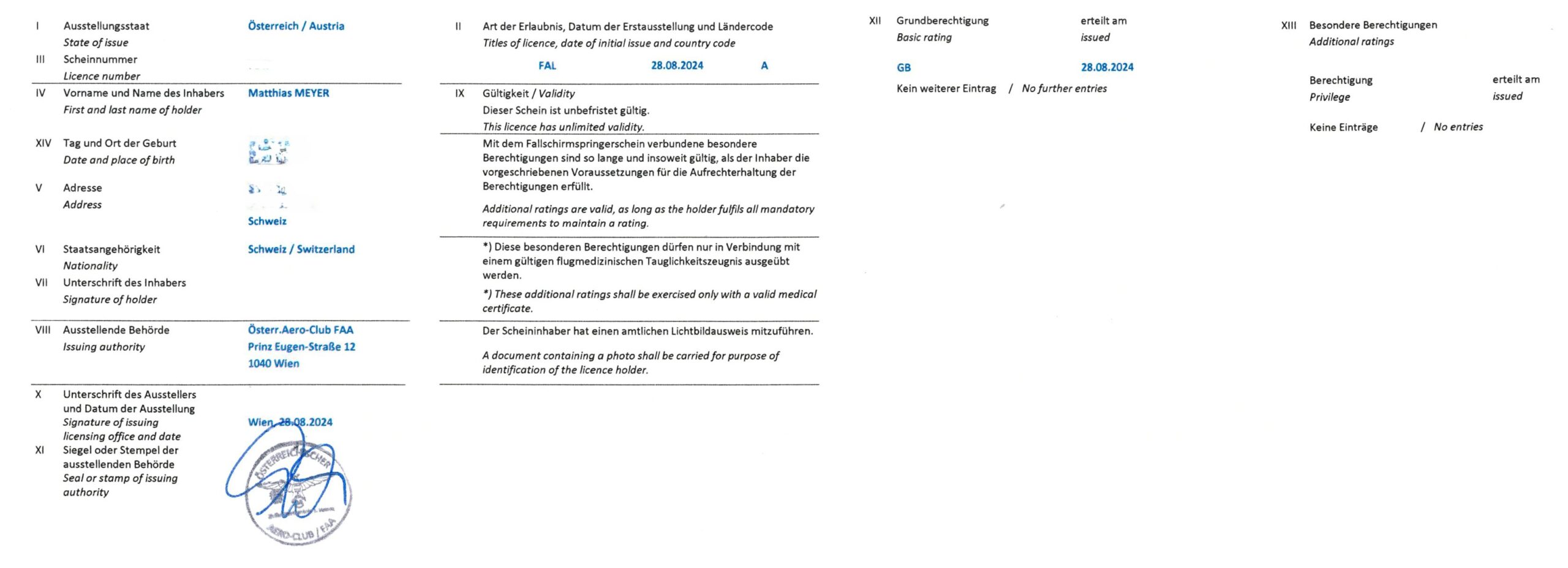
| Ratings Granted | FAL Parachutist License, GB Basic Rating, and Solo Packing Privilege |
| Related Progression | Documented in the Skydiving Logbook with 61 flights |
THE 800 METER LOW EXIT DRILL
The first mandatory phase of the examination curriculum was the low altitude exit jump, designed to simulate an in flight aircraft emergency where jumpers must evacuate swiftly below standard altitude. While a standard jump run begins at 4000 meters with nearly a minute of freefall, this emergency drill takes place at low altitude and requires an immediate hop and pop deployment within seconds of stepping through the door.
We boarded the reliable Cessna 208 Caravan for the jump run over the Rhine Valley. When the green light signaled the exit point, I stepped directly onto the camera step, presented my body squarely into the relative wind, and established a clean, symmetrical arch. As part of the strict examination protocol, I held stable orientation and looked back toward the open door, where my examiner displayed a visual hand number. I read the signal clearly, maintained heading without oscillation, and initiated the deployment sequence after approximately three seconds of subterminal descent.
The canopy opening was remarkably gentle, decelerating smoothly without the aggressive snatch force typical of terminal velocity deployments. Under the fully formed Navigator 260 parachute, I carried out the standard controllability checks, completed precision traffic pattern turns over the valley fields, and landed safely on the airfield target. Back on the ground, the instructors smiled as they checked the telemetry: while planned for 1000 meters, the actual exit had occurred at 800 meters. Because my focus was locked entirely onto body stability and the visual check with the examiner, the lower altitude went completely unnoticed until the post flight debriefing.
THE 4000 METER SOLO CHECK FLIGHT
The capstone requirement for the solo license was the comprehensive 4000 meter examination flight. Due to an operational aircraft rotation after the Cessna Caravan had sustained a landing gear incident, the dropzone operated a Pilatus PC6 Turbo Porter instead. Transitioning to the Porter brought an entirely different set of exit dynamics compared to the Caravan.
On the Caravan, the door area remains relatively calm until you drop below the fuselage. In contrast, opening the wide sliding door of the Pilatus Porter unleashes an intense turbine prop wash that sweeps along the side of the fuselage. Standing in the doorway felt like standing inside a wind tunnel, requiring solid footing and committed core tension to resist being pulled backward.
Stepping out into the prop blast caused a momentary wobble right at the threshold, as visible in the flight recording. Within two seconds, however, the relative wind caught the limbs, allowing me to settle into a solid belly to earth posture and stabilize my heading across the Rhine Valley. From there, the freefall progression flowed smoothly through controlled turns, tracking drills, and continuous altitude checks.
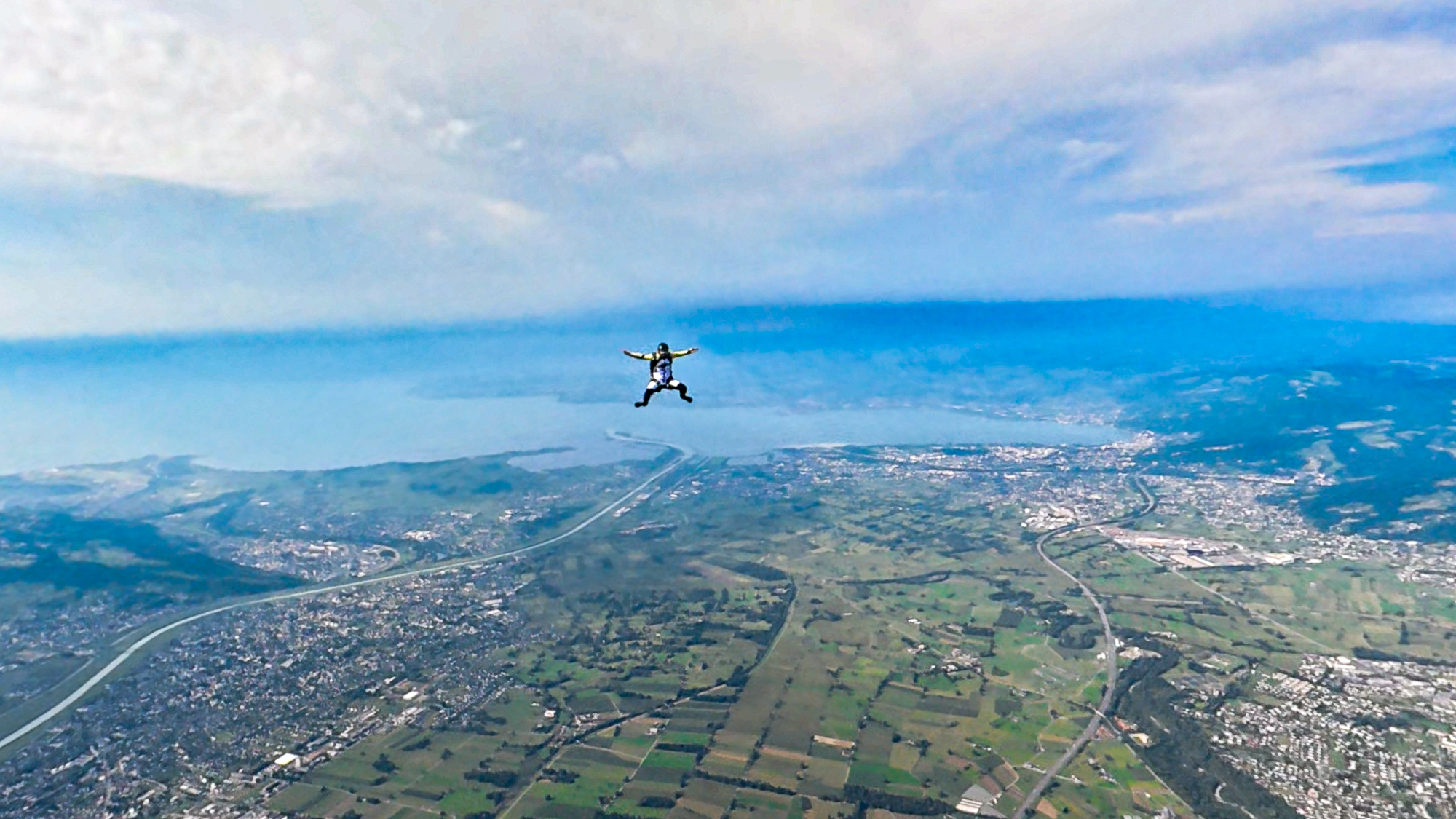
Because the jump run drifted slightly further downwind from the dropzone than anticipated, I opted to pull early at 1300 meters rather than the standard 1200 meter floor. Having that additional altitude provided ample glide distance under the rectangular canopy to cross the canal, enter the airfield pattern with comfortable margin, and set down softly on the turf landing strip.
EXAMINATION FLIGHT VIDEO
The unedited video documentation below captures the full 4000 meter examination jump from the Pilatus Porter, showing the energetic door exit into the propeller wash, the stabilization into flat freefall over Vorarlberg, and the clean pilot chute deployment above the Rhine Valley.
PARACHUTE PACKING CERTIFICATION
In addition to the practical flight maneuvers, earning the solo license requires passing an exhaustive parachute packing exam. Under the scrutiny of a certified rigger, candidates must demonstrate the ability to inspect the harness container, route line groups cleanly, flake the canopy cells, stow lines with balanced rubber band tension, and close the deployment pack correctly without any supervision.
Packing your own parachute is a profound psychological milestone in skydiving. It shifts complete responsibility for equipment safety onto the jumper, reinforcing meticulous mechanical discipline and deep familiarity with every component of the rig, from the three ring release system to the reserve static line and pilot chute spring.
OFFICIAL AERO CLUB LICENSING AND NEXT STEPS
With all flight drills, emergency procedures, theoretical exams, and packing tests successfully validated, the Österreichischer Aero Club issued my official Austrian Parachutist License (FAL) with basic rating (GB) and unrestricted validity. Earning this credential was the gateway to true athletic freedom in the sport.

Holding the solo license removed all student limitations. It enabled downsizing from large, docile training canopies to agile sport wings such as the Performance Designs Storm 180, and allowed me to jump across international dropzones without instructor sign offs. More importantly, it laid the foundation for advancing into group formation skydiving, multi person relative work, and vertical freefly disciplines, all chronicled in detail in my interactive Skydiving Logbook.
For a detailed breakdown of earlier student stages and ground school preparation, explore the initial Accelerated Freefall Course guide, or browse individual jump metrics and telemetry in the complete Skydiving Logbook.