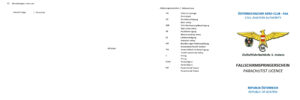
Passing the skydiving solo license examination at Hohenems airfield marked the beginning of an entirely new dimension of flight. The student phase focused on fundamental altitude awareness, stable belly arching, and solo emergency procedures. Once licensed, the real progression began. The transition from the forgiving student Navigator 260 canopy to the agile 9 cell Performance Designs Storm 180 opened up sharper turns, dynamic landings, and faster flight speeds. More importantly, it granted the freedom to jump in groups, experiment with multi orientation flying, and explore the physics of formation skydiving.
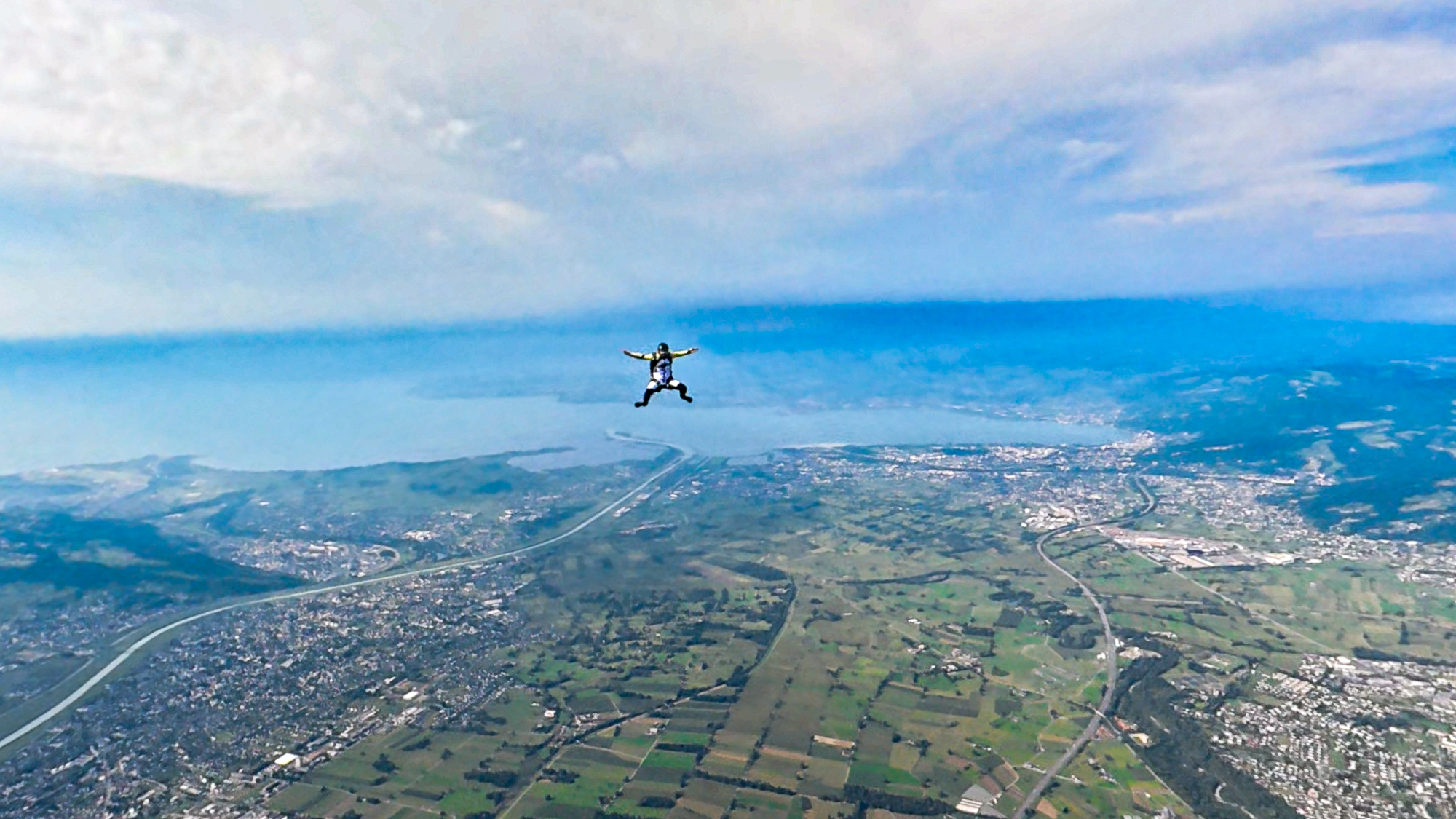
The jumps logged below trace this progression across 61 freefall flights over the Rhine Valley and Lake Constance. From early Accelerated Freefall student levels through solo maneuver drills, two way formation exits, forward flips, and advanced hybrid dives where vertical sit flyers dock onto belly bases, each jump provided valuable aerodynamic lessons.
QUICK FLIGHT SPECIFICATIONS
| Dropzone Location | Hohenems Airfield (LOIH), Vorarlberg, Austria |
| Total Logged Jumps | 61 flights (AFF student levels to group freefly) |
| Primary Aircraft | Cessna 208 Grand Caravan (N208PC) and Pilatus PC6 Porter (DFPTF) |
| Exit Altitude | 4000 meters above ground level (plus 800 meter emergency low exit drill) |
| Cumulative Freefall | 50 minutes and 03 seconds of total freefall time |
| Sport Wing | Performance Designs Storm 180 (9 cell tactical canopy) |
| Student Wing | Performance Designs Navigator 260 (student training canopy) |
| Certification Path | Swiss Skydive and USPA standard solo licensing |
INTERACTIVE SKYDIVING LOGBOOK
The interactive logbook below provides a complete digital record of all 61 jumps. You can search by jump number, aircraft, canopy model, or specific maneuvers, filter by discipline, sort chronologically, and export the entire dataset as a CSV file for flight logging records.
Hohenems Skydiving Logbook
Chronological jump history, freefall metrics, aircraft, and progression disciplines
| # | Date | Discipline | Group | Aircraft | Canopy | Exit | Freefall | Remarks & Maneuvers |
|---|---|---|---|---|---|---|---|---|
| Loading logbook data... | ||||||||
PROGRESSION HIGHLIGHTS AND VIDEO LOGS
While every jump delivers valuable airtime, two specific milestone flights after receiving the solo license stand out for technical coordination, aerial maneuvers, and multi orientation teamwork.
Jump 37: Two Way Launch and Synchronized Front Flip
Jump 37 was planned as a dynamic two way formation dive from 4000 meters. The objective was to execute a clean exit from the side door of the Grand Caravan, establish instant eye contact and relative stability, and then introduce an intentional acrobatic element. Right after launching into the 200 kilometer per hour airflow, we stabilized on heading. I initiated a forward salto front flip, tucking tightly to rotate around the pitch axis and opening back up immediately into a balanced belly position with zero altitude wobble or heading drift. We closed distance, took grips, held the formation steady, and broke off smoothly at 1300 meters.
Jump 53: First Hybrid Formation Dive
Jump 53 was my maiden hybrid formation dive, combining two fundamentally different body orientations in a single linked freefall group. Two teammates flew in a belly to earth orientation to establish a steady, level base. Meanwhile, I flew vertically in a sit fly posture, descending toward the base to dock and hold hand grips.
The sensory shift in a hybrid dive is immense. A vertical body position has a significantly smaller cross section against the airflow, creating natural fall rates upwards of 240 kilometers per hour. To dock with a belly base traveling at 195 kilometers per hour, the vertical flyer must actively increase surface area, flaring arms and legs outward to cup the air and slow down to match the base speed. Holding a solid dock while upright above a horizontal base requires delicate throttle control with the legs and steady eye contact. When the break off altitude arrived, the dock released cleanly, the vertical flyer tracked outward first to establish horizontal separation, and everyone deployed safely under open skies.
AERODYNAMICS OF HYBRID SKYDIVING
Hybrid skydives are among the most visually striking and technically demanding disciplines in sports aviation. Because participants fly in different orientations, managing differential fall rates and relative wind vectors requires thorough preflight briefing and tight discipline in the air.
- Predictable belly base: The horizontal belly flyers must provide a rock solid, level platform without hunting for altitude, giving vertical flyers a trustworthy target.
- Fall rate regulation: Freeflyers in sit or head down positions generate much higher speeds. Approaching the formation requires feathering the airflow with the limbs to bleed off excess velocity before closing distance.
- Approach discipline: Flyers must never charge directly into a dock. The safe approach protocol requires stopping forward and downward motion just off the formation, matching level and speed, and then closing the final inches to take clean grips.
- Staggered separation altitudes: Because vertical flyers accelerate rapidly when disengaging, break off altitudes must be stepped. Freeflyers transition to flat tracking first, gaining horizontal distance before belly flyers begin their separation run.
THE JOURNEY FROM AFF STUDENT TO LICENSED DIVER
Looking through the 61 entries in the logbook reveals a structured progression curve through modern skydiving education:
- Accelerated Freefall levels 1 to 7 (Jumps 1 to 7): Initial jumps with dual and single instructors, learning basic altitude awareness, practice ripcord touches, heading control, solo 360 degree turns, forward movement, and unassisted main canopy deployment.
- Solo maneuvers and emergency drills (Jumps 8 to 29): Solo flights practicing controlled side exits, dive exits from the aircraft door, forward saltos, barrel rolls, and recovery back to belly stability. Jump 29 featured an 800 meter emergency low exit drill, executing an immediate hop and pop canopy opening within seconds of leaving the door.
- License examination (Jump 30): The formal solo check flight under examiner supervision, demonstrating precision spot exits, acrobatic figure eight turns, clean back loop recovery, altitude monitoring, and spot on runway landing.
- Relative work and group formations (Jumps 35 to 57): Post license progression with two way, three way, and five way formation skydiving, learning relative fall rate adjustment, docking discipline, and wide tracking circuits.
- Vertical freefly exploration (Jumps 58 to 61): Dedicated multi orientation flights introducing sit flying dynamics, vertical balance, and 3D aerial navigation.
CORE SKYDIVING DISCIPLINES OVERVIEW
Modern skydiving encompasses diverse specialized disciplines, each demanding distinct equipment setups, body flight mechanics, and safety protocols:
- Formation Skydiving: Also known as Relative Work or belly flying, teams build geometric formations in freefall by linking grips while maintaining horizontal orientation.
- Freefly: Three dimensional body flight utilizing vertical orientations including sit flying, stand up flying, and head down flight with speeds often exceeding 260 kilometers per hour.
- Tracking and Angle Flying: Flying the body as an aerodynamic wing to convert vertical gravity into rapid forward horizontal speed, carving expansive paths across the sky.
- Wingsuit Flight: Using specialized ram air wingsuits with fabric cells between arms and legs to achieve incredible glide ratios and extended freefall durations exceeding three minutes.
- Canopy Piloting: High performance flight under parachute, carving high speed turns into final approach to swoop horizontally across landing zones at high velocity.
- Canopy Formations: Docking parachutes together in flight by linking feet into canopy lines, requiring specialized equipment and dedicated formation briefings.
TRAINING LOGISTICS AT HOHENEMS AIRFIELD
Hohenems Airfield (LOIH) sits in the Vorarlberg Rhine Valley, just across the Swiss border between Dornbirn and the southern shore of Lake Constance. The location offers spectacular alpine panoramas during jump run, with the Swiss Appenzell Alps to the west and the Austrian Bregenzerwald to the east. Turbine aircraft such as the Cessna Grand Caravan climb to 4000 meters in around fifteen minutes, providing efficient flight rotations. Safe operations require steady awareness of local valley wind patterns and careful traffic management alongside general aviation gliders and touring aircraft.