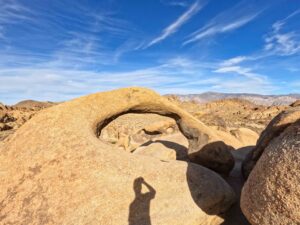
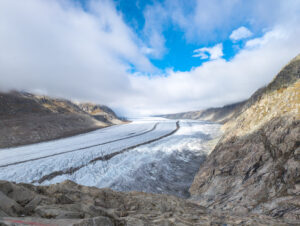
Returning to southern Spain only a year and a half after a spring kitesurfing trip to Tarifa offered an opportunity to trade the windy Atlantic strait for the architectural and geological landmarks of inland Andalusia. Over a long autumn weekend in late October 2026, I flew from Zurich down to Malaga, picked up a rental car to establish a base in the historic crossroads town of Antequera, and spent a full day exploring the fourteenth century Nasrid Palaces and Generalife gardens of the Alhambra in Granada.
Beyond the Moorish palaces and Mediterranean beaches, the trip turned into a test of patience with Spanish car rental agencies, chaotic urban traffic, an unpredictable sightseeing train in Granada, and an unexpected Monday morning aircraft turbine failure that transformed a simple return flight into an eighteen hour overland and air odyssey across Spain via high speed rail and Madrid. Below is the complete travelogue, historical background, and financial summary from the weekend.
TABLE OF CONTENTS
- Quick Facts Specification Sheet
- Flight to Malaga, Rental Car Hassles, and Antequera
- The Alhambra of Granada and the Nasrid Palaces
- Palace of Charles V, Alhambra Museum, and the Generalife Gardens
- Granada City Center and the Sightseeing Train Fiasco
- El Torcal Karst Limestone, Malaga Beach, and Rental Car Return
- The Monday Return Odyssey via High Speed Train and Madrid
- Financial Summary and Detailed Trip Expenses
QUICK FACTS: ANDALUSIA WEEKEND SPECIFICATION SHEET
| Destination | Andalusia and Madrid, Spain (Malaga, Antequera, Granada, El Torcal, Madrid) |
| Travel Period | October 23 to October 26, 2026 |
| Duration | 4 Days, 3 Nights |
| Primary Basecamps | Antequera (2 Nights) and Malaga Beachfront (1 Night) |
| Key Historical Landmarks | Nasrid Palaces, Alcazaba, Palace of Charles V, Generalife Gardens, Antequera |
| Transport Modes | Commercial flights, economy rental car, iryo high speed train, urban buses |
| Visited and Completed | October 2026 |
FLIGHT TO MALAGA, RENTAL CAR HASSLES, AND ANTEQUERA
On Friday, October 23, 2026, the journey began at 07:30 on the local bus toward Zurich Airport. It was a sunny autumn morning in Switzerland, though brisk at around 8 degrees Celsius. At 10:30, I boarded easyJet flight EJU7038 bound for Malaga. Sitting in the cabin, it felt almost surreal to be flying back to southern Spain only eighteen months after my kitesurfing trip to Tarifa in April 2025. Although the aircraft departed and landed with a slight delay, the flight itself was very pleasant, made even more entertaining by a family seated directly in front of me speaking a lively mix of Swiss German and Spanish.
After touching down at Malaga Airport, I rode the shuttle bus out to the off terminal car rental depot. I had prepaid 30.67 euros through Booking.com and Auto Europe for a three day rental with NizaCars. Unfortunately, the friction started immediately at the counter. Even though my written voucher explicitly stated that the booking included unlimited kilometers, the agent at the desk insisted that I was restricted to only 200 kilometers per day. Having a written contract stating the exact opposite was immediately annoying, though I reminded myself that I carry legal protection insurance, so any improper mileage charge afterward would simply become a case for them to handle.
On top of the mileage dispute, instead of operating a normal full to full fuel policy, the tank was handed over only three quarters full with instructions to return it at the exact same mark. Rental companies clearly use partial fuel policies on purpose, knowing that almost every driver brings the vehicle back with more fuel than when they picked it up. Those two practices left a poor first impression of NizaCars, even though the Hyundai i20 itself was modern and clean, albeit with Android Auto disabled on the dashboard unit.
From the airport depot, I drove straight into central Malaga, which Google Maps estimated at thirty minutes. Navigating Malaga city traffic proved to be a chaotic experience. Drivers constantly overtook on both sides, cut across solid white lines, and forced their way into the front of turn lanes even where lane directions were strictly separated. Rather than letting the aggressive traffic get to me, I decided to look on the positive side and treat the extra minutes in the city as a free sightseeing drive through Malaga.
After parking in an underground garage for 7.40 euros, I spent some time in town and stopped at an authentic neighborhood bar that offered good value away from overpriced tourist traps, ordering a sandwich and bread before heading out of the city. From Malaga, the drive north to Antequera was straightforward, following nearly the same highway the entire way inland through the mountains, where I parked in a free street space just outside the center.
Known to the Romans as Antikaria and later called Medina Antaquira under Moorish rule, Antequera sits at the geographic heart of Andalusia, right where the road corridors linking Malaga, Granada, Cordoba, and Seville intersect. That strategic position made it a prime staging point for the medieval frontier campaigns of the Reconquista, including the capture of the town by Regent Ferdinand of Antequera in 1410, and makes it an ideal base today for driving across the region.
That Friday evening, I was still waiting for my entry tickets to the Alhambra in Granada. Because standard 22 euro tickets on the official patronage portal routinely sell out two months in advance, and I had organized this trip only one month ahead, all official allocations were long gone. Instead, I had booked a 65 euro package through Viator that promised 100 percent guaranteed ticket delivery at least 24 hours before the visit. Yet by Friday night, nothing had arrived in my inbox. Rather than getting frustrated, I decided to sleep on it and check again in the morning. Sure enough, at 01:00 in the morning, the tickets finally arrived, with my entry to the Nasrid Palaces adjusted slightly from the requested 12:30 slot to 11:30.
THE ALHAMBRA OF GRANADA AND THE NASRID PALACES
Waking up at 09:00 on Saturday, October 24, left no time to linger, as the highway drive east from Antequera across the fertile Vega de Granada plain takes roughly ninety minutes. By 10:45, I had guided the car into the underground parking garage at the Granada Congress Center (Palacio de Congresos). When I stepped out onto the street, police officers were stationed on every corner. Because I was dressed quite neatly, the officers actually mistook me for a politician arriving for the summit and immediately began gesturing me toward the VIP congress entrance. I later learned that the Prime Minister of Spain was attending an official congress inside the building that day, which explained the heavy security cordon.
When I asked the officers for directions to the Alhambra instead, they smiled and pointed me up the steep hill. I walked briskly up the wooded climb and reached the access pavilions slightly sweaty, but right on time for my 11:30 entry window. Even though the Viator ticket had been issued under my passport number while I only had my Swiss identity card in my wallet, the attendant at the turnstile waved me through without issue.
I spent the next two hours exploring the Nasrid Palaces, followed by another two hours walking through the Generalife gardens, the museums, the Alcazaba fortress, and the surrounding complex. Because the official audio guide did not work properly for me, I conversed with AI on my smartphone as I walked from courtyard to courtyard, which provided deep historical and architectural background on every hall and inscription.
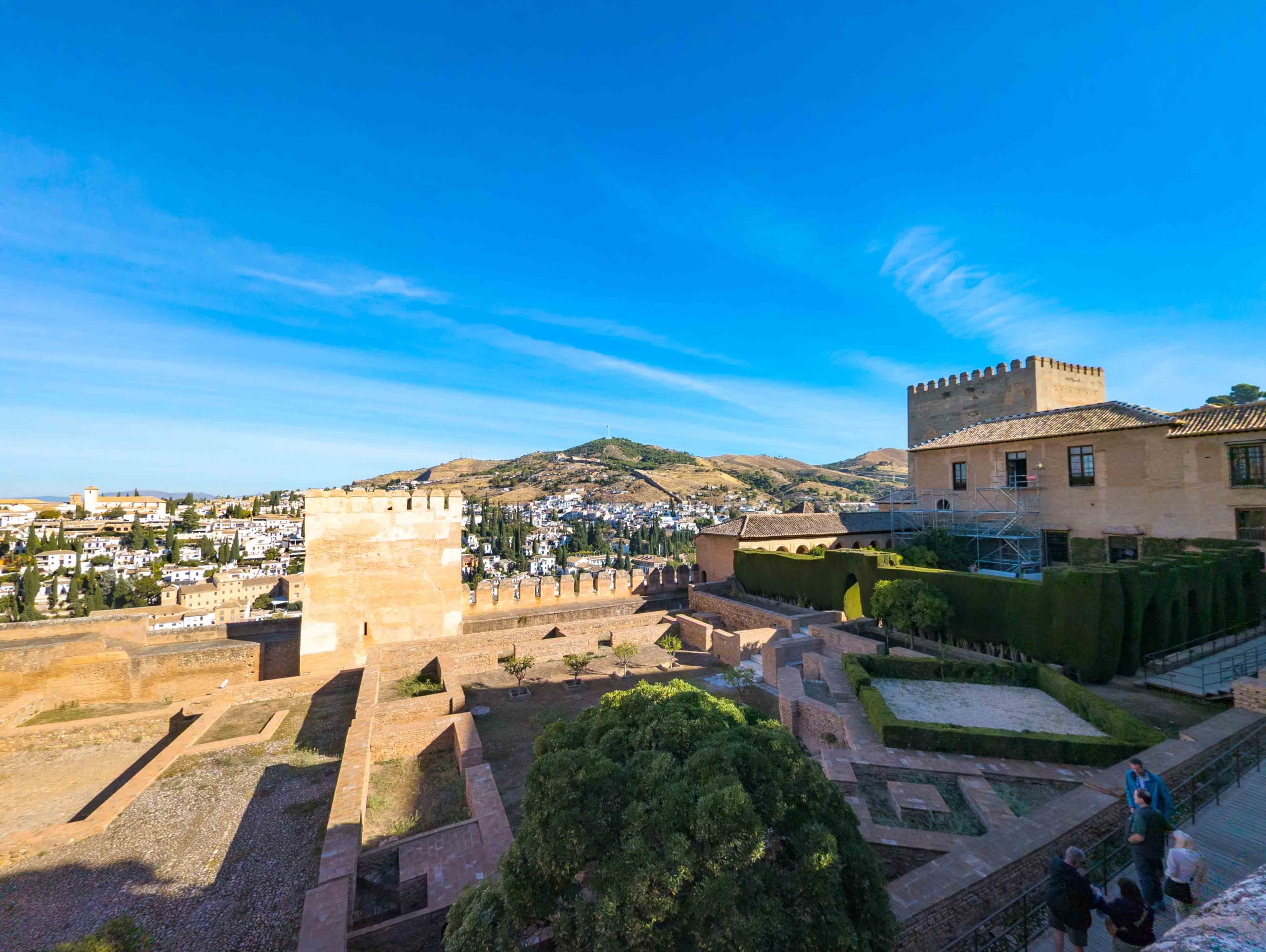
Perched atop the rocky Sabika hill high above the Darro River against the backdrop of the Sierra Nevada mountains, the Alhambra takes its name from the Arabic Al Qala al Hamra, meaning The Red Fortress, a reference to the warm ferruginous clay used to construct its rammed earth tapial perimeter walls. While a modest military fortress existed on the ridge during the ninth century Zirid period, the complex transformed into a royal palatine city after 1238, when Muhammad I (Ibn al Ahmar) founded the Nasrid Dynasty. For over two and a half centuries, while the rest of the Iberian Peninsula fell to the Christian kingdoms of Castile and Aragon, the Emirate of Granada endured as the final Islamic state in Western Europe, flourishing as a center of mathematics, hydraulic engineering, poetry, and architecture until its surrender to the Catholic Monarchs Ferdinand and Isabella in January 1492.
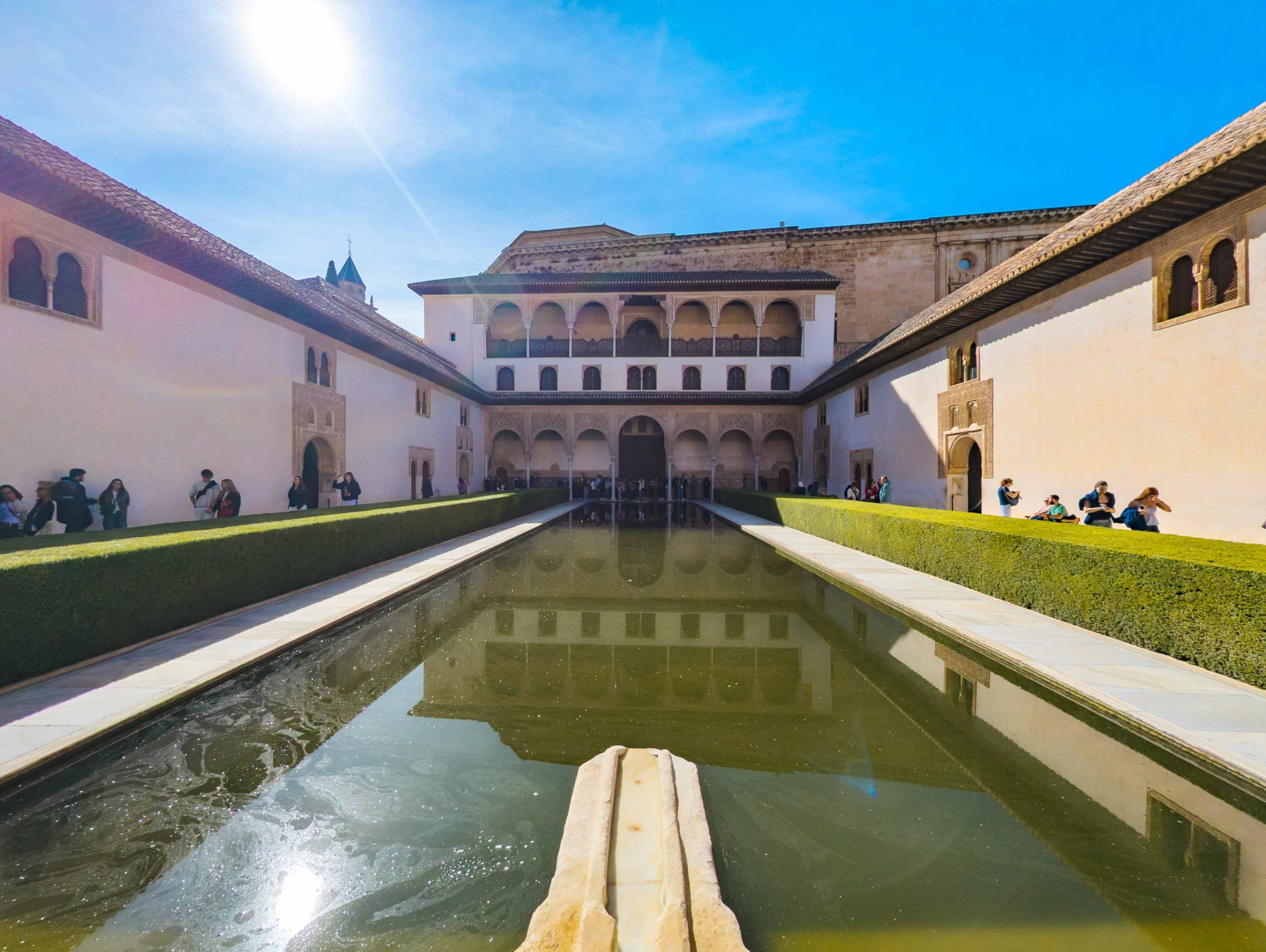
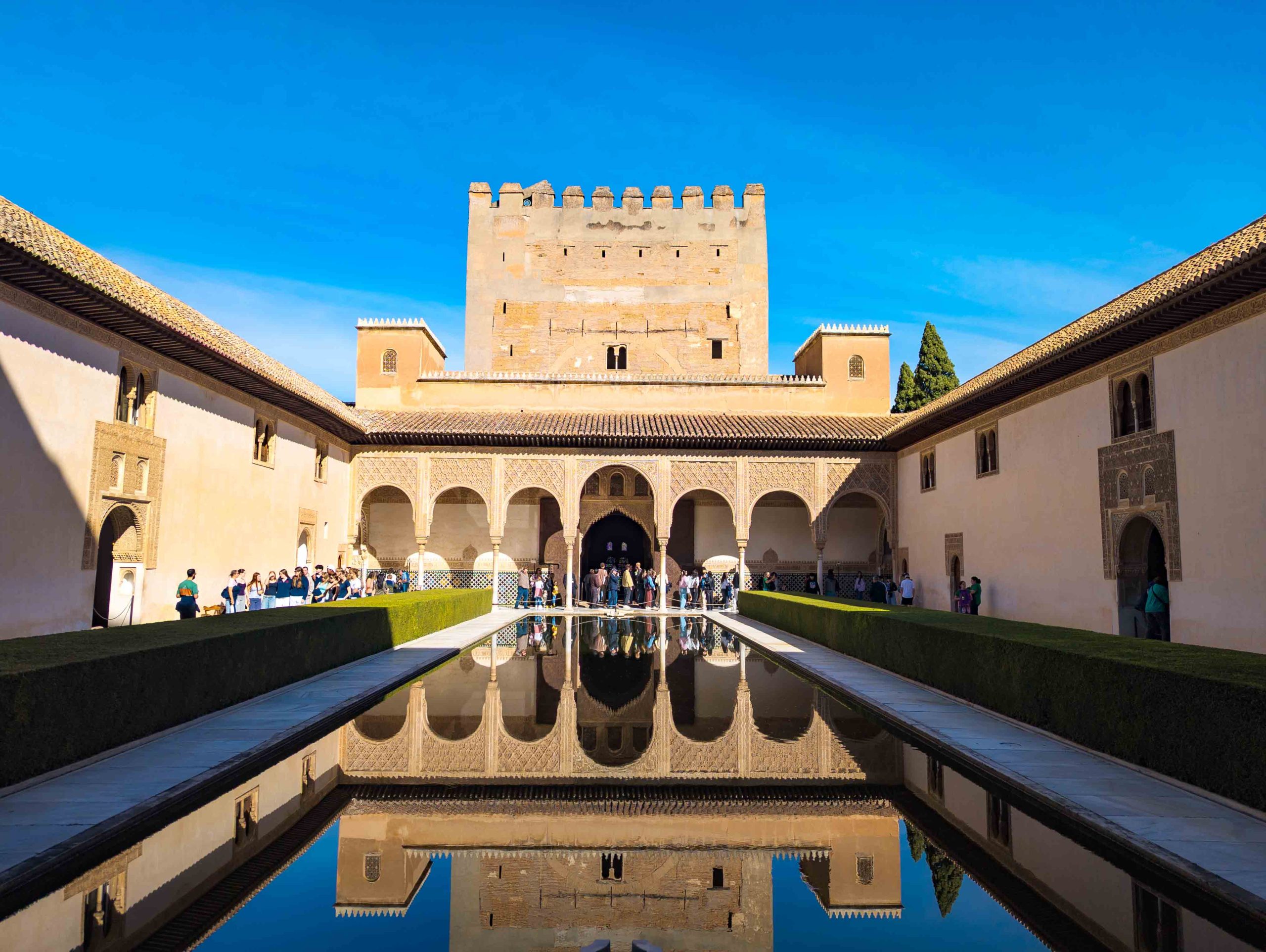
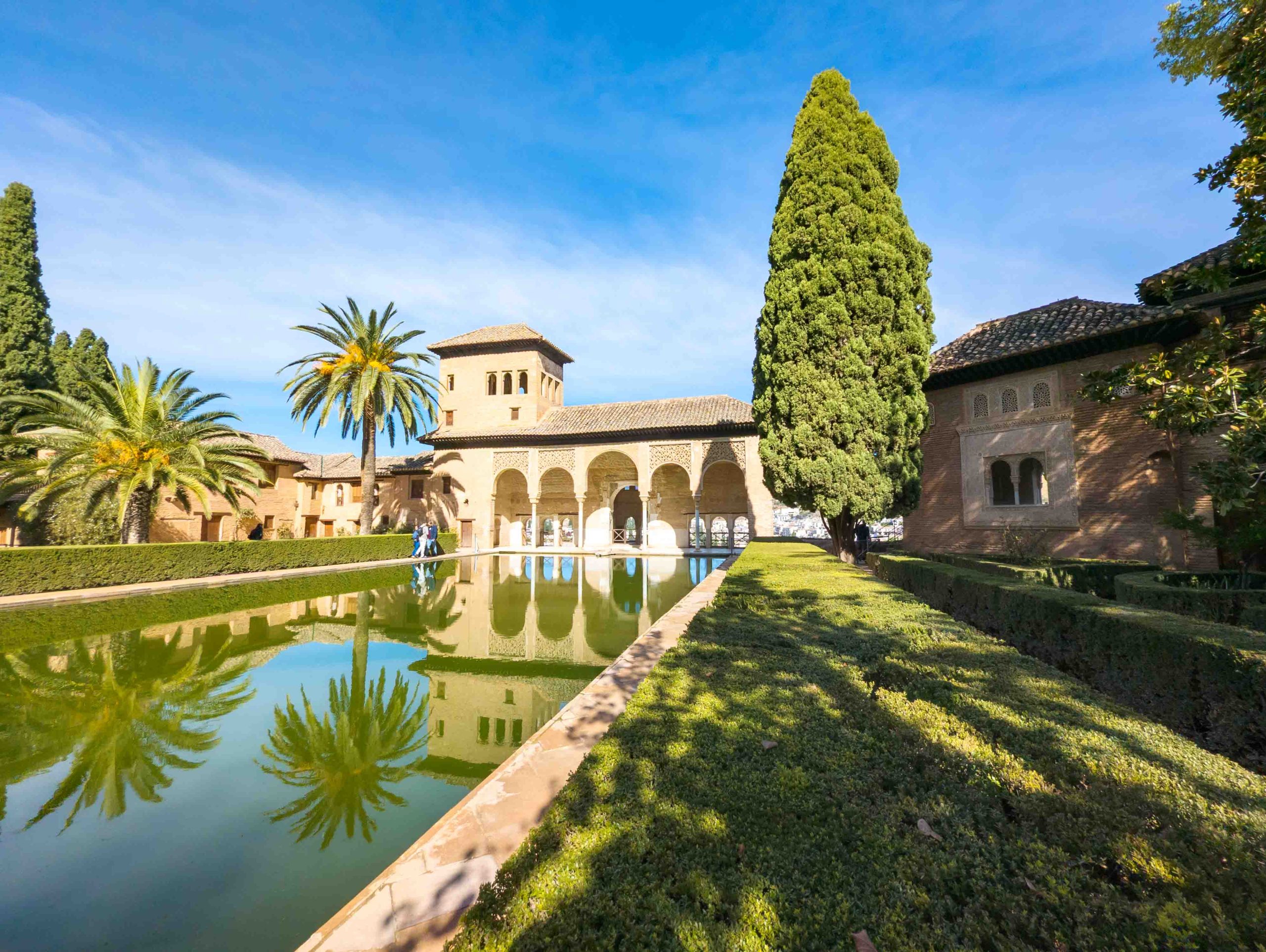
The heart of the complex is the fourteenth century Nasrid Palaces, built primarily under Sultans Yusuf I and his son Muhammad V. Rather than constructing a single monolithic stone keep like contemporary European monarchs, Nasrid architects organized the royal residence into separate inward looking courtyard units designed around water, light, and geometric proportion. In the Mexuar and the Comares Palace, official state diplomacy unfolded around the Court of the Myrtles (Patio de los Arrayanes), where a long emerald reflecting pool bordered by trimmed myrtle hedges cools the surrounding porticos and casts a mirror image of the 45 meter Comares Tower against the blue Andalusian sky.
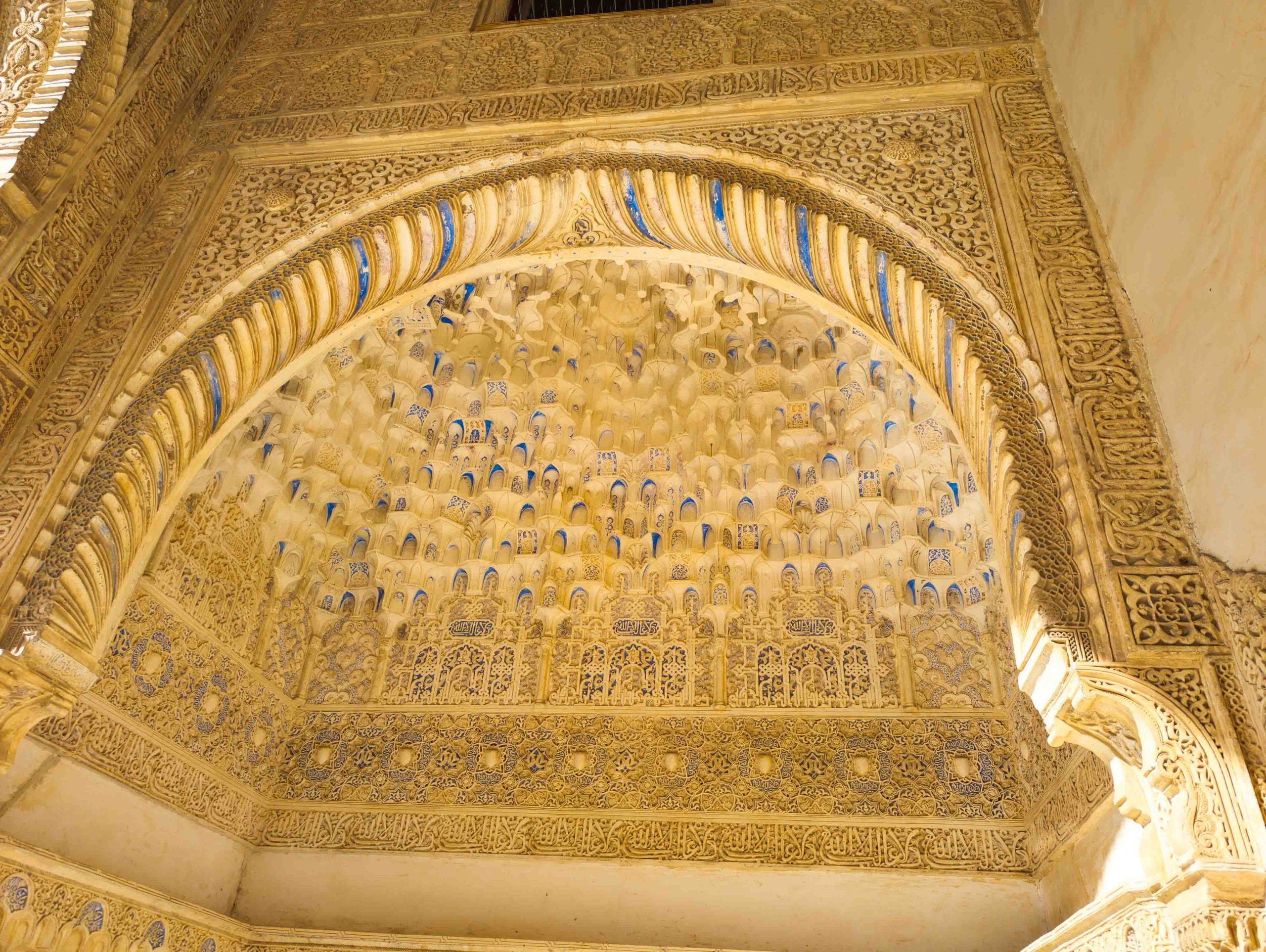
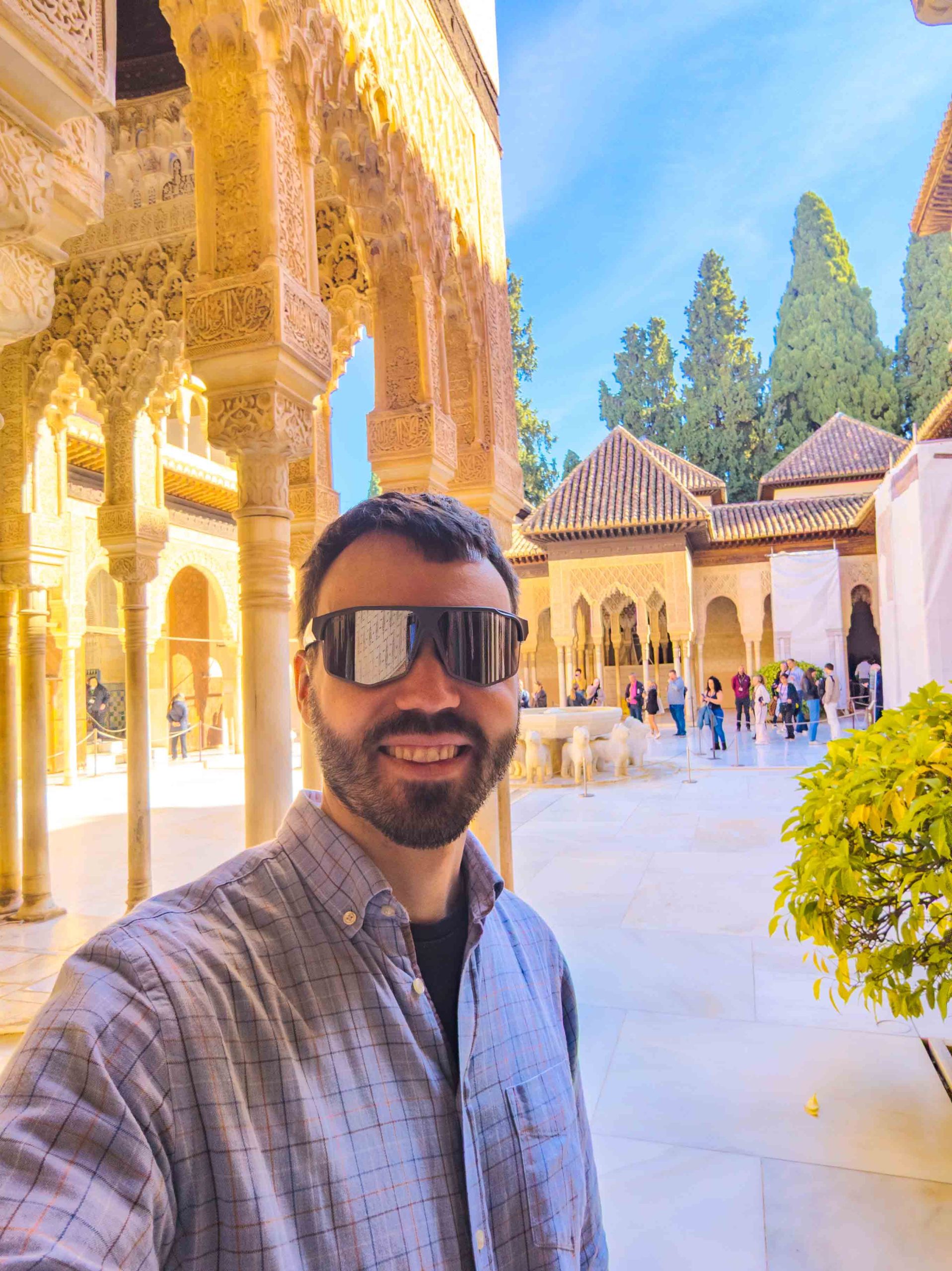
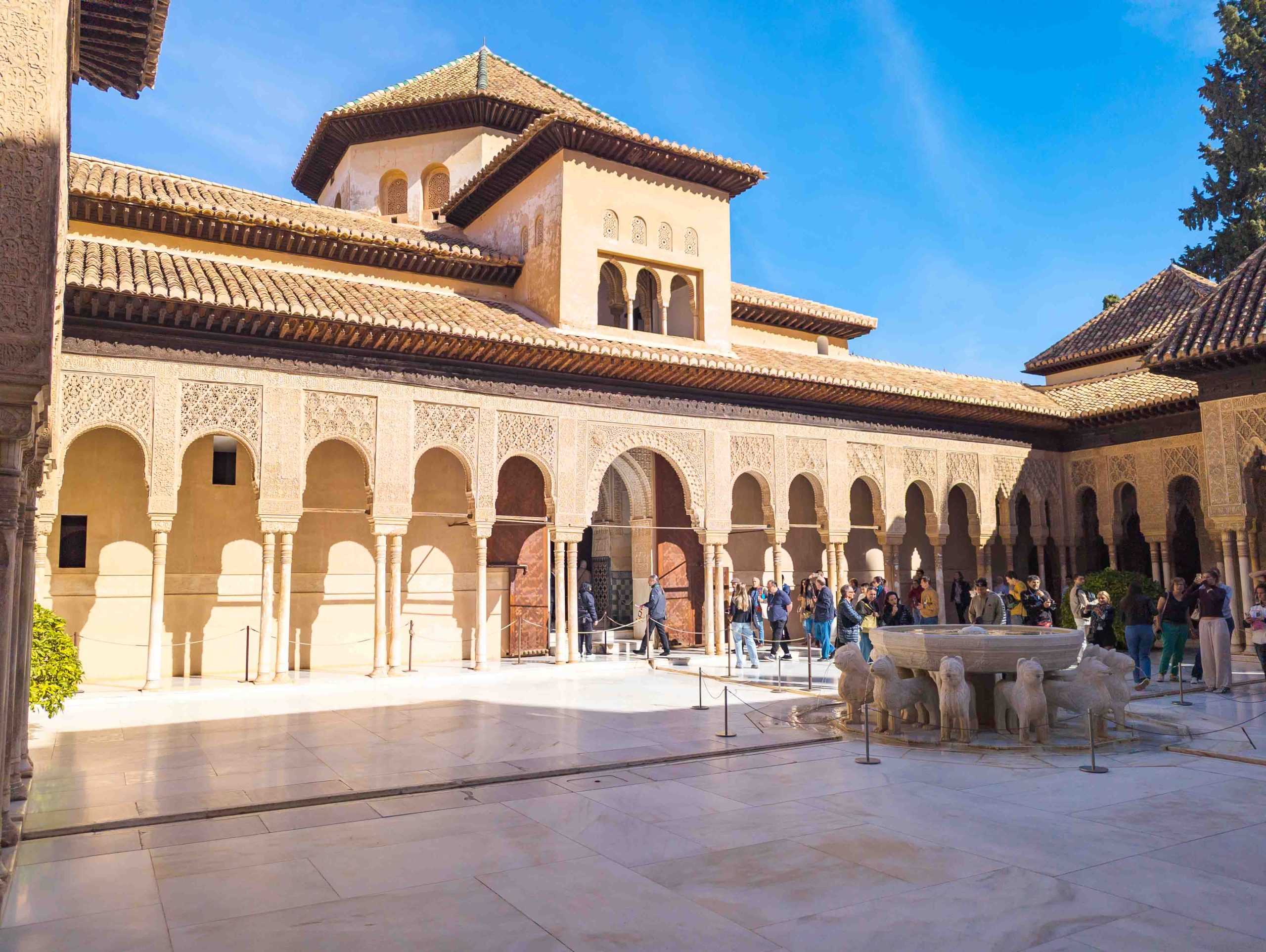
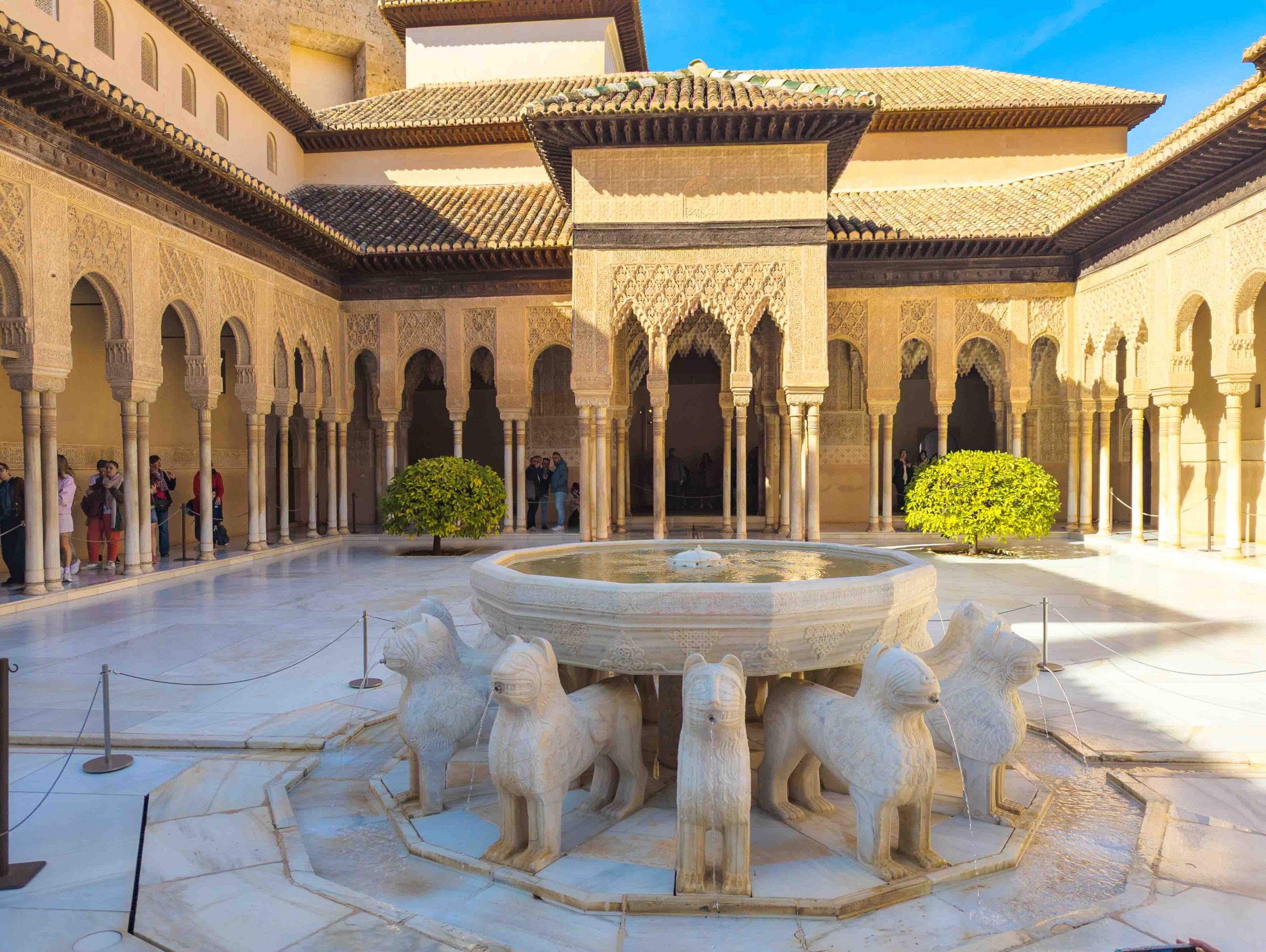
Stepping from the Comares Palace into the private royal quarters reveals the famous Court of the Lions (Patio de los Leones), commissioned by Muhammad V between 1362 and 1391. The courtyard is ringed by a delicate forest of 124 slender white Macael marble columns supporting filigreed stucco pavilions crafted to evoke the palms of a desert oasis. At the center stands an alabaster basin resting on the backs of twelve carved white marble lions, fed by four intersecting marble water channels symbolizing the four rivers of Paradise. To supply these fountains atop a dry rocky spur, Nasrid engineers constructed the Acequia Real, a six kilometer hydraulic canal that tapped the Darro River far upstream and relied entirely on gravity, settling tanks, and calibrated pipe diameters to deliver continuous water pressure without mechanical pumps.
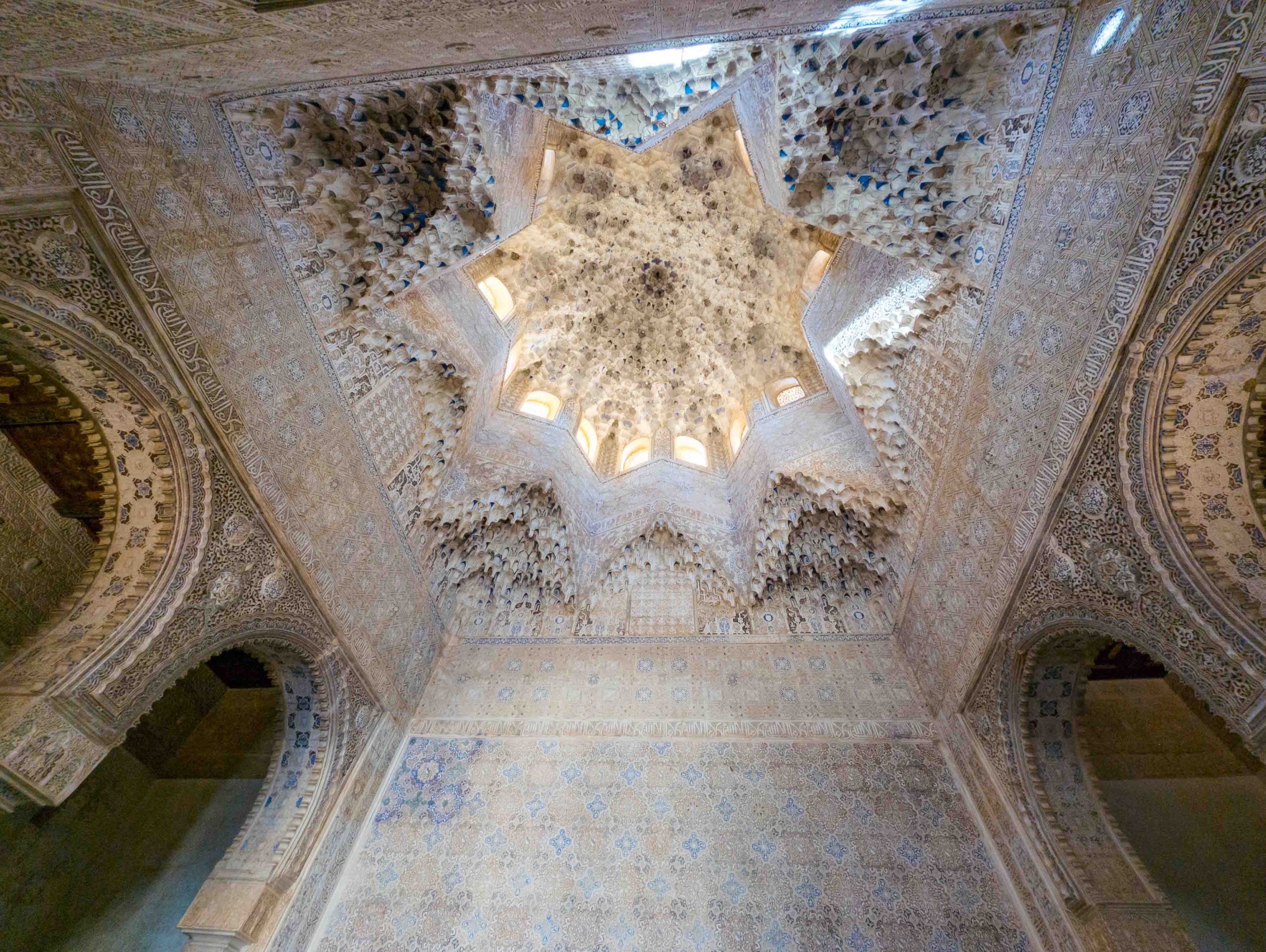
Flanking the courtyard are the Hall of the Abencerrajes and the Hall of the Two Sisters (Sala de las Dos Hermanas). Looking straight up inside the Hall of the Two Sisters reveals one of the greatest masterpieces of Islamic geometric vaulting: an octagonal muqarnas honeycomb dome composed of more than five thousand individual carved plaster prisms. Illuminated by sixteen clerestory windows around its base, the ceiling catches and diffuses the changing sunlight to resemble a revolving canopy of stars, while the walls below are covered from glazed ceramic dadoes to the cornice with carved stucco calligraphy repeating the Nasrid dynastic motto, There is no victor but God.
PALACE OF CHARLES V, ALHAMBRA MUSEUM, AND THE GENERALIFE GARDENS
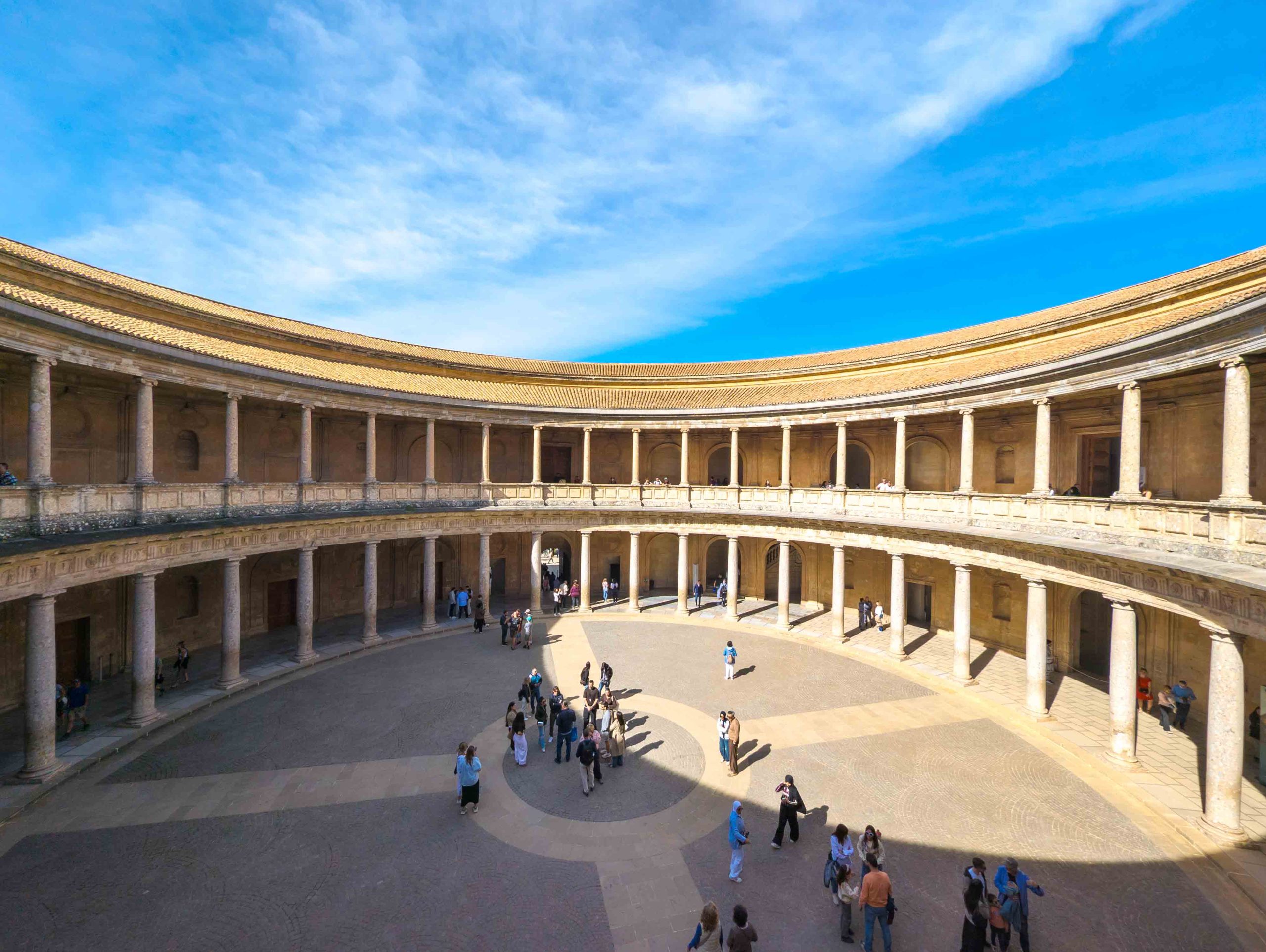
Immediately adjacent to the delicate stucco halls of the Nasrid Palaces stands a striking architectural contrast: the massive stone facade of the Palace of Charles V. Following his marriage in 1526, Holy Roman Emperor Charles V (King Charles I of Spain) wished to establish a permanent imperial residence inside the Alhambra that projected the power of Christian Rome right at the center of the former Moorish citadel. Designed in 1527 by Spanish architect Pedro Machuca, who had trained in Italy under the circle of Raphael and Michelangelo, the building is one of the purest examples of High Renaissance architecture outside Italy. Behind its rusticated square exterior of 63 meters per side hides an extraordinary circular courtyard measuring 30 meters in diameter, ringed by a lower Doric colonnade of conglomerate stone and an upper Ionic gallery.
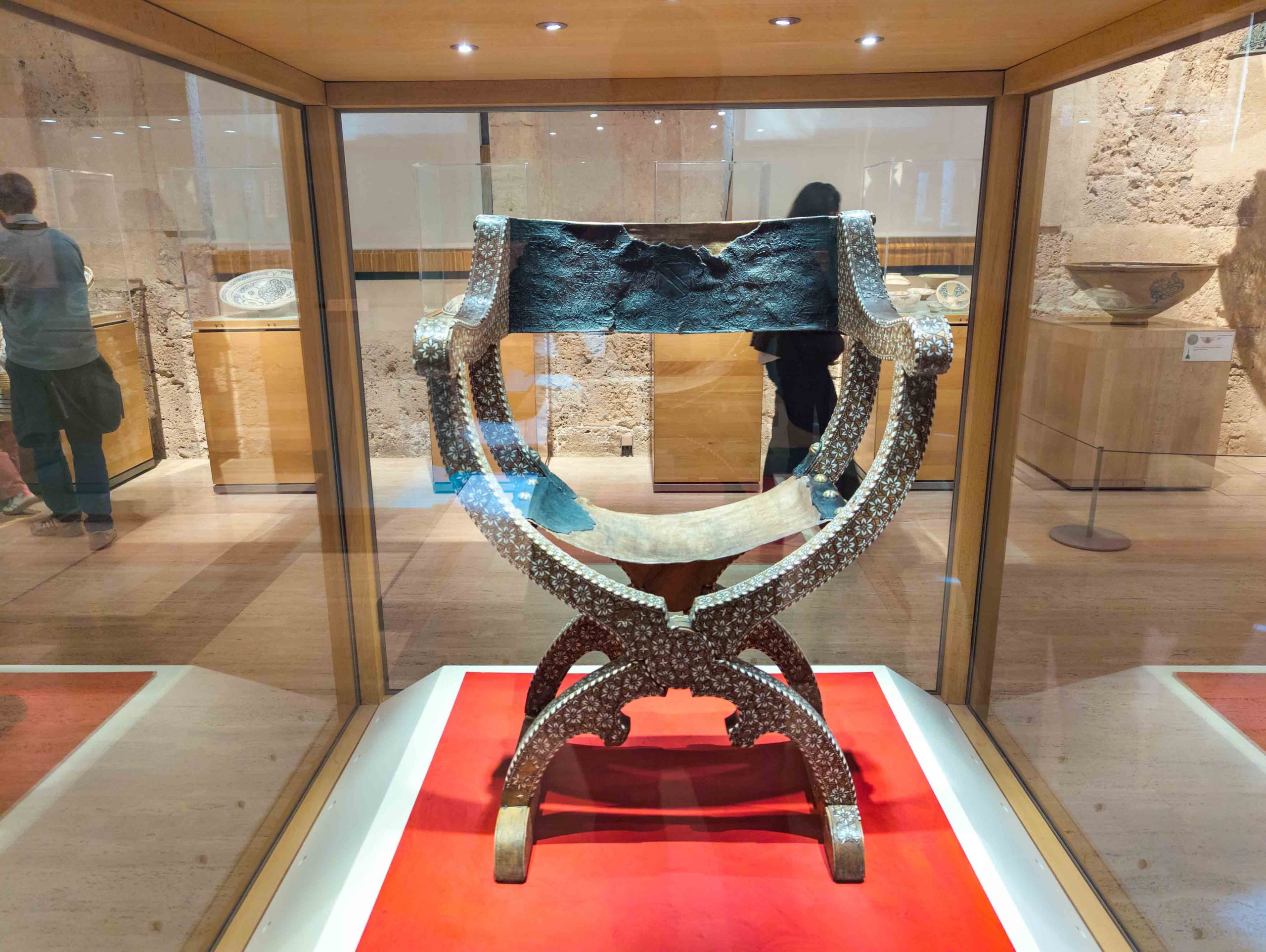
The ground floor of the Palace of Charles V today houses the Alhambra Museum, which preserves original architectural fragments, ceramics, and woodwork rescued from the palaces over the centuries. Among the standout artifacts on display in the glass cases is an original fifteenth century Nasrid folding hip chair (known in Spanish as a jamuga or silla de cadera), crafted from wood inlaid with thousands of tiny bone and dark wood geometric stars (taracea) and fitted with a tooled leather seat and backrest bearing coats of arms.
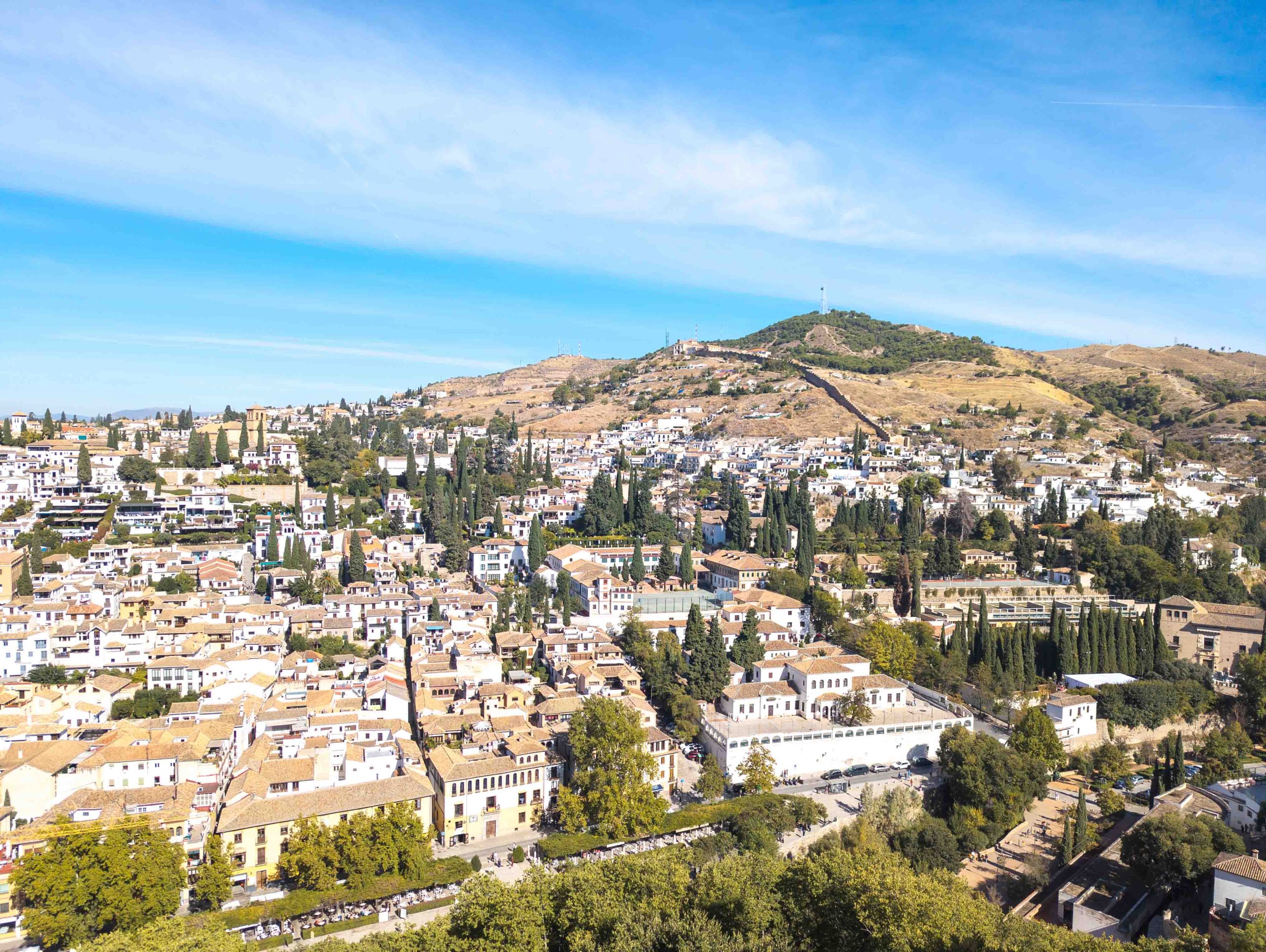
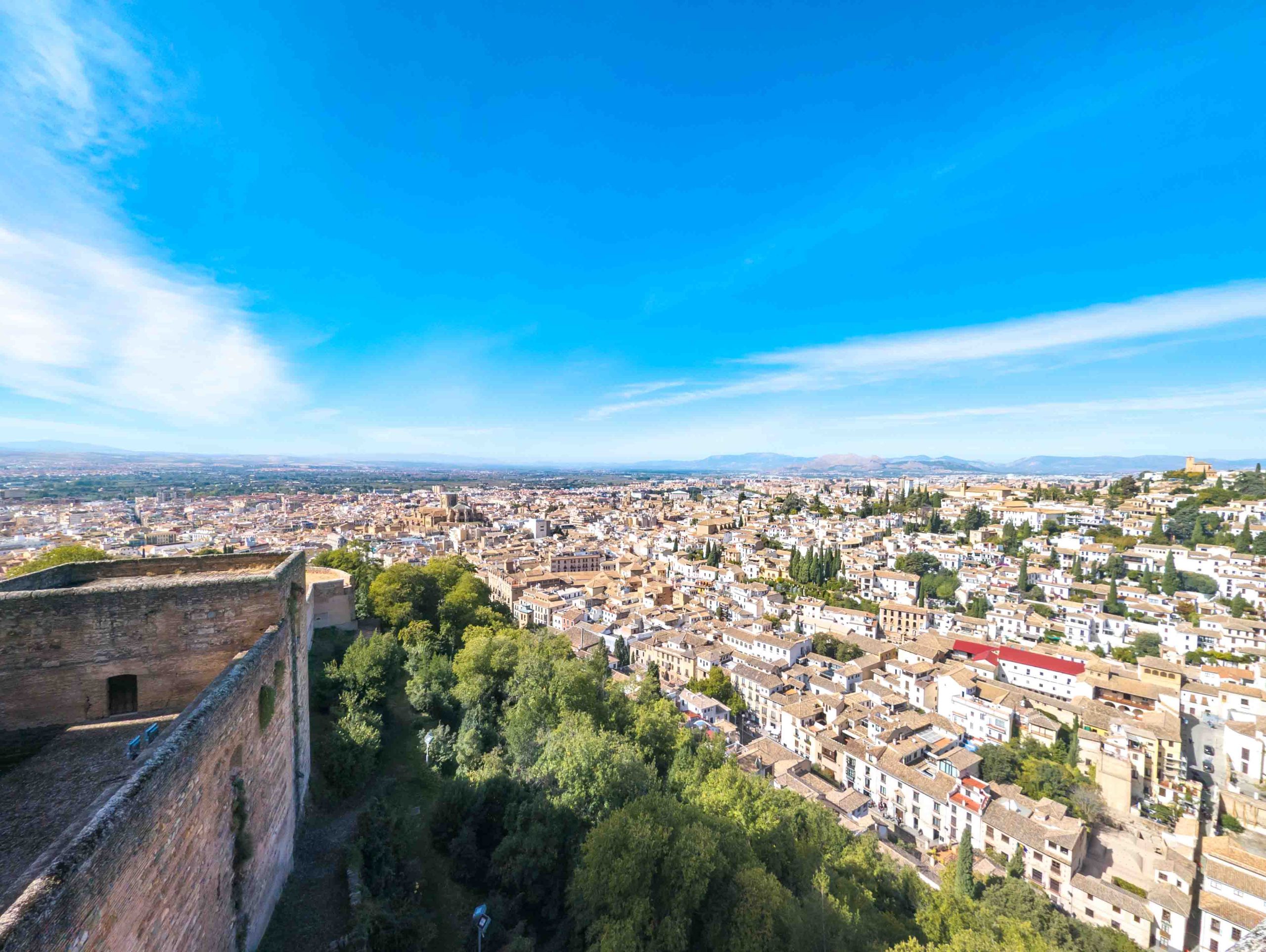
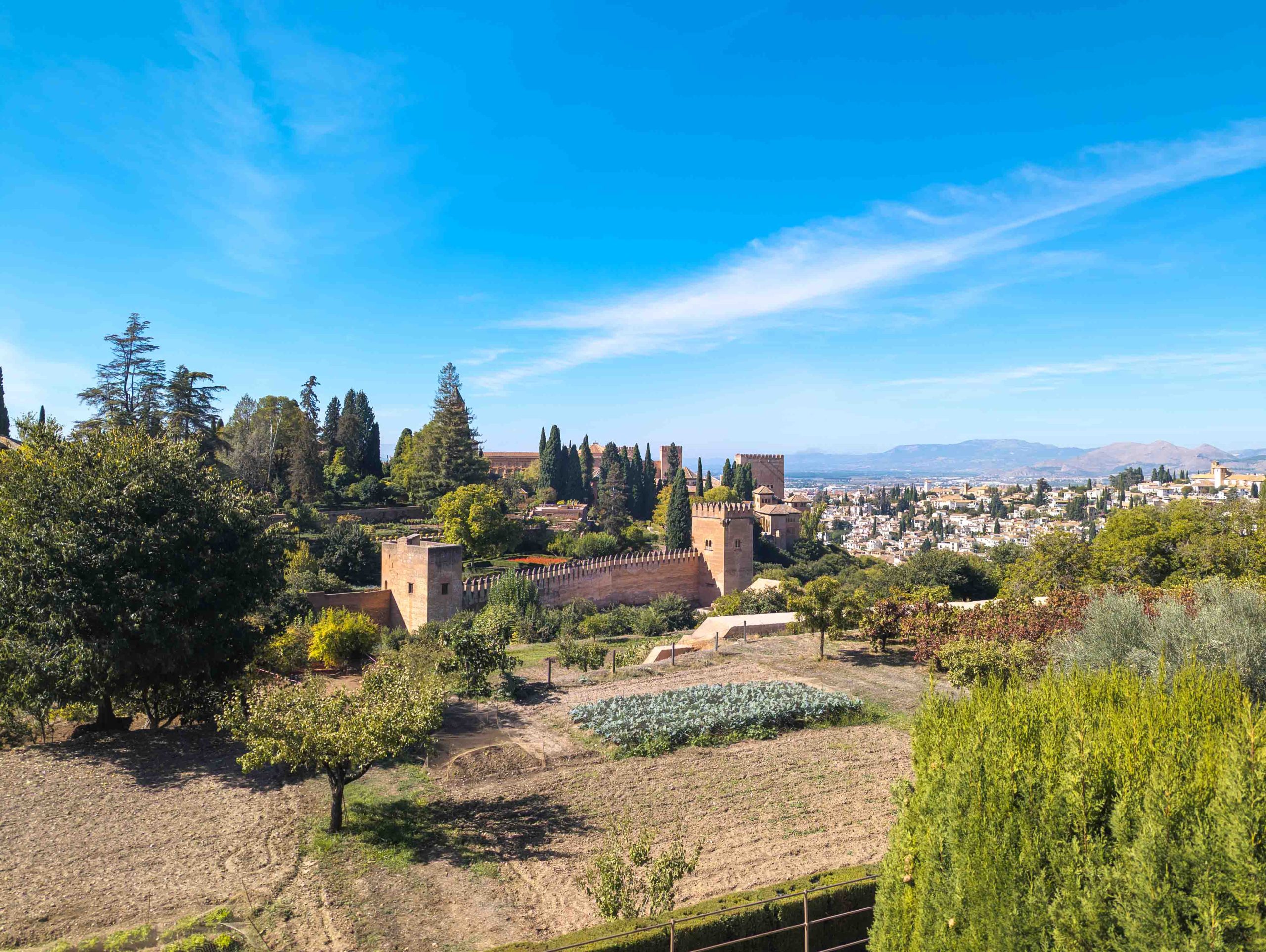
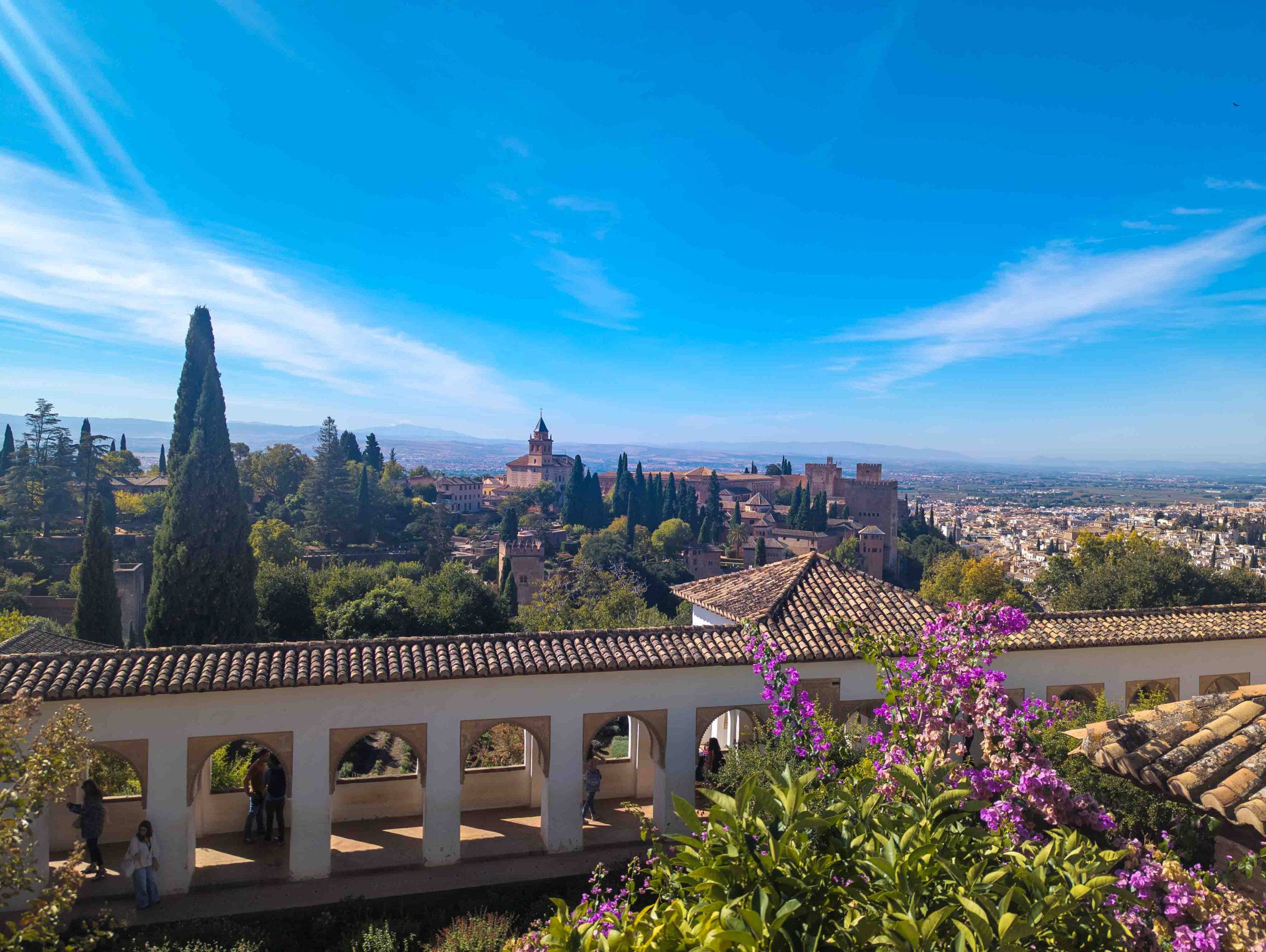
At the western tip of the hill rises the Alcazaba, the oldest fortified enclosure of the Alhambra, whose watchtowers command a sweeping 360 degree panorama across the dense terracotta rooftops of Granada, the Renaissance dome of Granada Cathedral, and the whitewashed hillside caves and houses of the Albaicin and Sacromonte neighborhoods. Crossing the ravine to the east leads into the Generalife (from the Arabic Jannat al Arif, meaning Garden of the Architect), the rural summer estate where Nasrid rulers retreated from court protocol among terraced vegetable orchards, cypress alleys, purple bougainvillea, and the water jets of the Patio de la Acequia.
GRANADA CITY CENTER AND THE SIGHTSEEING TRAIN FIASCO
By the time I completed the Alhambra circuit in the afternoon, I had not eaten anything all day and walked down into the historic center of Granada in search of a late lunch. I looked up the highest rated Neapolitan pizza in Granada on Google Maps and walked to the top recommendation. When I placed my order at the counter, however, they informed me that I could not eat inside because the shop lacked a municipal dine in license. In the end, I carried the box outside and ate my pizza sitting on a stone ledge along the street, which still tasted great after four hours on foot. Afterward, I stopped at a local barbershop for a haircut and decided to try the Granada tourist sightseeing train, really an articulated multi car bus, since a pass for it was already included with my Viator Alhambra package.
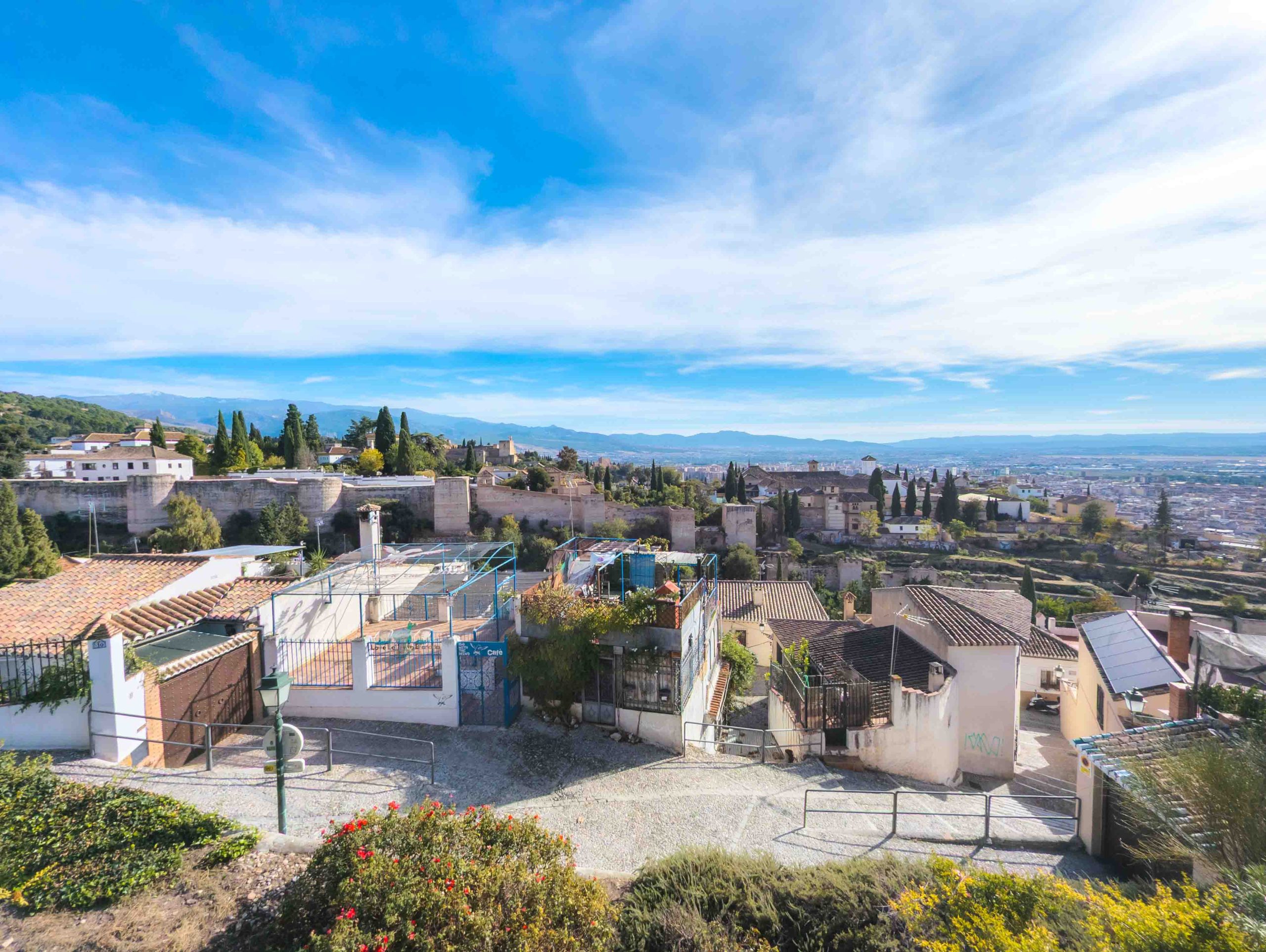
That tourist train turned out to be a complete comedy of errors. Normally, an urban hop on hop off sightseeing service follows a fixed loop with predictable stops, but in Granada the driver seemed to improvise the route at random and nobody onboard ever knew which stop would come next. I hopped off at an elevated viewpoint in the Albaicin to take photos looking back across the valley toward the Alhambra walls, and then waited at the signposted stop for the next train. Instead of arriving every twenty to thirty minutes as advertised, it took more than an hour to show up.
By that point, my smartphone battery was running low after hours of photography and navigation, so I stayed onboard intending to ride back down to the Congress Center stop to grab my powerbank from the rental car. Instead of following the numbered route sequence, the train jumped straight from Stop 5 to Stop 10, crawling for forty minutes through heavy city traffic only to deposit us right back up at the Alhambra entrance. A massive crowd of tourists holding valid tickets was waiting at the platform. Even though our carriages were half empty, the driver became so annoyed at the pressing crowd that he refused to let anyone board except two Chinese passengers who had stood quietly at the side. Watching that unfold, I honestly felt like I was in the wrong movie.
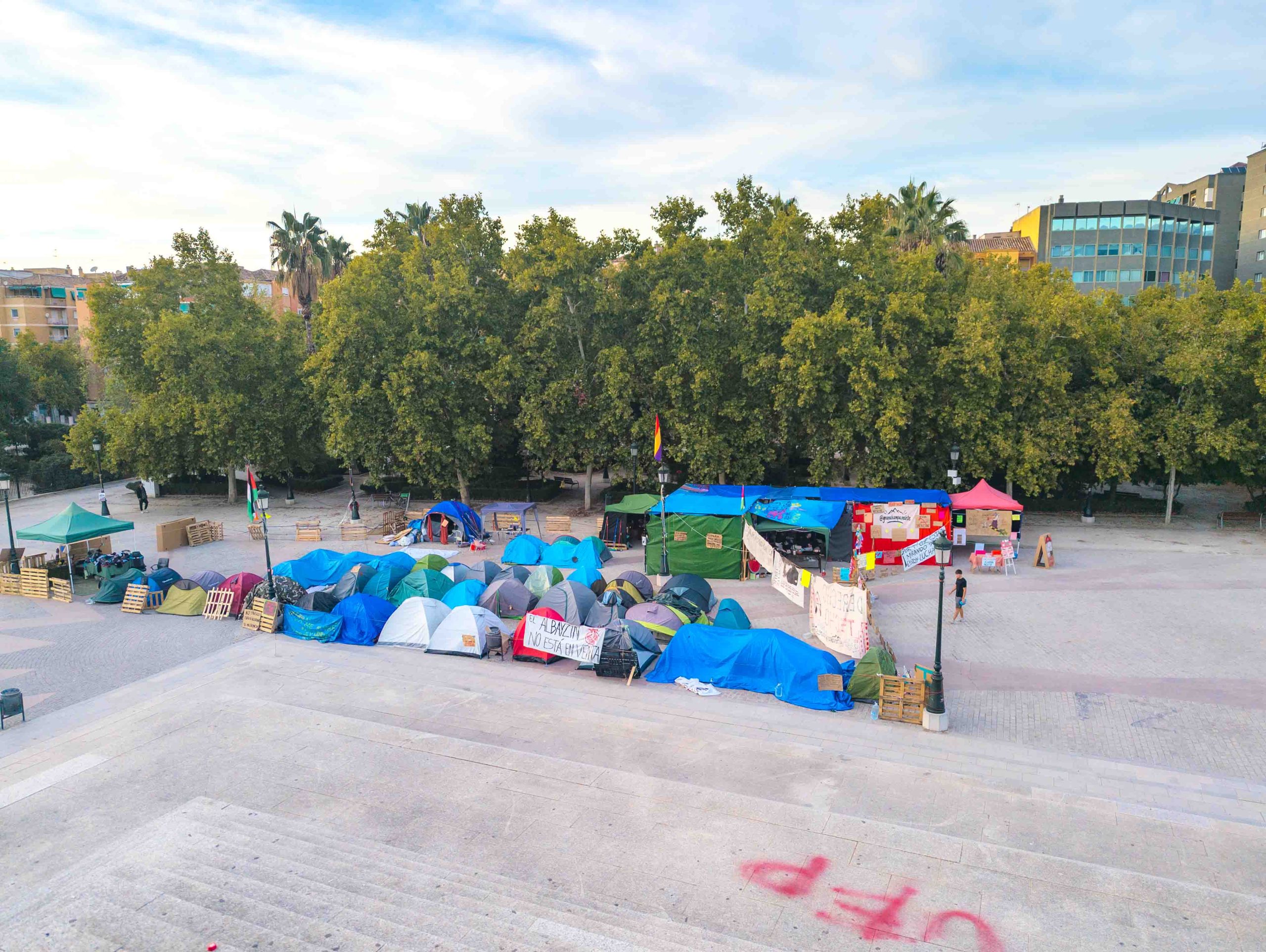
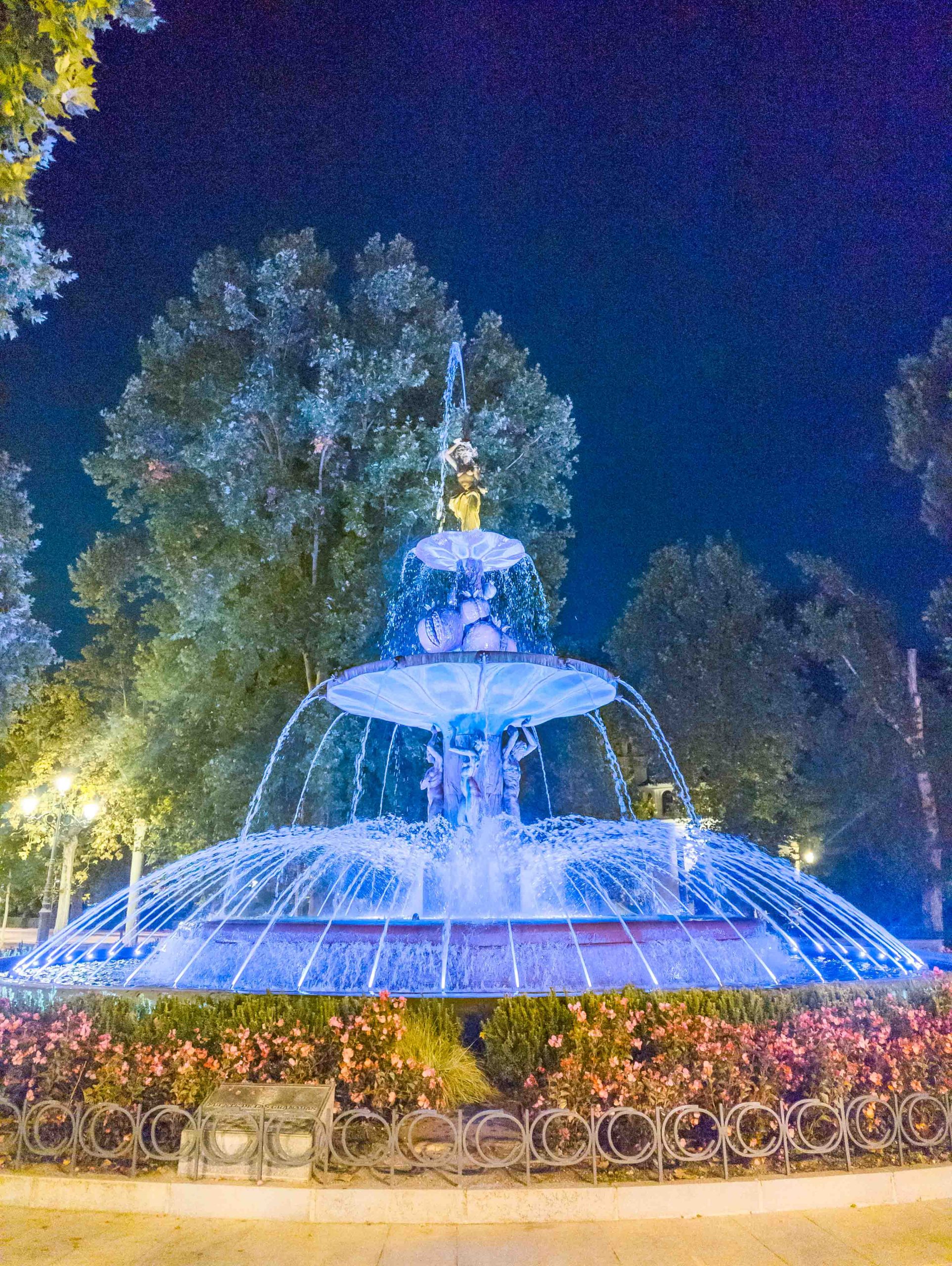
After another thirty minutes of erratic driving down the hill, the train finally passed near the Congress Center. I retrieved my powerbank from the car to recharge my phone, walked past the plaza in front of the congress building where demonstrators had pitched an encampment of colorful protest tents and banners, and strolled back into the city center for the evening. Sitting on a square near the illuminated Fuente de las Granadas watching local life pass by until 19:00, I eventually walked back to the garage and made the ninety minute night drive back to Antequera.
EL TORCAL KARST LIMESTONE, MALAGA BEACH, AND RENTAL CAR RETURN
On Sunday morning, October 25, I caught up on sleep and got up around 11:00. After breakfast and a walk through the streets of Antequera, I drove south up the winding mountain road toward the famous rock formations of El Torcal de Antequera.
Rising over 1,200 meters above sea level just south of Antequera, El Torcal is recognized as a UNESCO World Heritage site and represents one of the most dramatic karst limestone landscapes in Europe. Its geological story began roughly 150 million years ago during the Jurassic period, when southern Iberia lay submerged beneath the prehistoric Tethys Ocean, a marine corridor linking the primitive Atlantic and Mediterranean basins. Over millions of years, the calcium carbonate skeletons and shells of marine organisms settled onto the ocean floor, compacting into thick horizontal beds of limestone.
During the Cenozoic Alpine orogeny, tectonic compression between the African and Eurasian plates folded and uplifted this ancient seabed more than a kilometer into the sky. Because the uplift preserved the horizontal bedding planes while fracturing the rock with vertical joints, millions of years of slightly acidic rainwater, wind, and winter freeze thaw cycles dissolved and hollowed out the fissures through differential erosion, sculpting the mountainside into surreal stacks of stone pancakes, natural corridors, and mushroom shaped pillars.
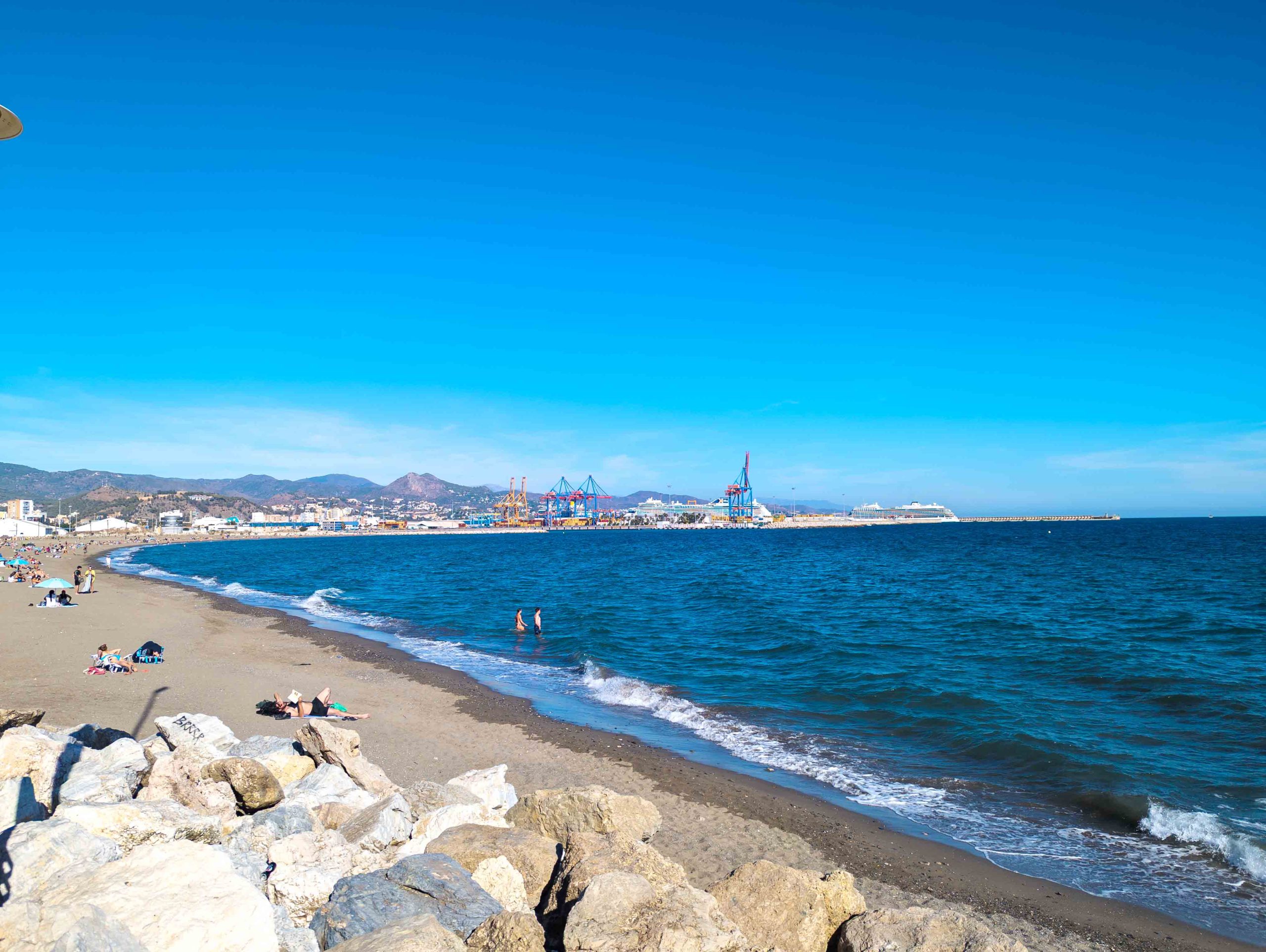
Unfortunately, after driving quite a long way up the mountain approach, traffic was halted near the top and we were informed that the upper access road into the reserve was closed to vehicles. Unable to drive any further to reach the upper rock trails, I turned the car around and drove straight down from the mountains to the coast in Malaga. Finding a free street parking spot near the waterfront, I spent the late afternoon walking along Malagueta Beach in the warm autumn sunshine with views across the bay to the port cranes and cruise ships, had dinner in town, and checked into my Airbnb (Alojamiento Playa 2, booked for 31.12 euros) for the final night.
Around 20:00, I headed out toward Malaga Airport to return the rental car before the 21:00 deadline. Because NizaCars required the fuel needle to sit at the exact three quarters mark, I had to stop and put small amounts of gasoline into the tank three separate times until the dashboard gauge finally matched the pickup line. Returning the car at the NizaCars yard was once again a frustrating experience. The inspector claimed I had made a scratch on the lower front right bumper that was barely visible to the naked eye, and which was almost impossible to see even after wiping across it with a finger. Because that lower corner was not clearly visible in my pickup video, they insisted on filing a damage report that billed over 310 euros against the deductible, leaving me to submit another reimbursement claim with my TCS ETI protection policy. Afterward, I rode the shuttle to the airport terminal, caught the EMT city bus back to downtown Malaga for 4 euros, arrived at the Airbnb around 22:30, took a shower, and went straight to bed.
THE MONDAY RETURN ODYSSEY VIA HIGH SPEED TRAIN AND MADRID
On Monday morning, October 26, my alarm sounded at 03:45. I ordered a Bolt ride for 18 euros and arrived smoothly at Malaga Airport for my 06:00 easyJet flight EJU7037 back to Zurich, scheduled to touch down at 08:45. Security and boarding went without a hitch until everyone was seated onboard the aircraft and a sudden power outage plunged the cabin into silence. A short while later, the captain announced that the electronics inside one of the jet turbines had overheated, requiring all passengers to deboard back into the terminal.
Once inside the gate area, easyJet provided no real information or ground assistance, leaving passengers to fend for themselves. Initially a single easyJet flight the next day on Tuesday appeared in the system, but it booked out within minutes, meaning the next available easyJet departure to Switzerland would not have been until Wednesday. Waiting until Wednesday was completely out of the question for me, so I decided to take matters into my own hands: travel north across Spain to Madrid by high speed train and catch an evening flight to Zurich from there.
That decision kicked off a full day travel odyssey. Having woken up at 03:45 and taken a taxi out to Malaga Airport, I now had to ride the airport express bus right back into the center of Malaga to the Maria Zambrano railway station. After picking up food and drinks for the journey at the Mercadona supermarket inside the station concourse, I boarded the 11:34 iryo high speed train 06021 bound for Madrid Puerta de Atocha.
Cruising north at up to 300 kilometers per hour across the mountains of Cordoba and the plains of Castile La Mancha offered an unexpected window into the agricultural geography of Spain. For mile after mile, the hillsides outside the train window were covered in an unbroken geometric carpet of millions of olive trees stretching to the horizon. Watching that landscape roll past prompted me to look up the numbers: Spain is by far the largest producer of olive oil in the world, generating nearly half of total global output, with the region of Andalusia alone accounting for roughly eighty percent of the Spanish harvest.
The high speed train glided into Madrid Puerta de Atocha at 14:22, covering more than 500 kilometers in just two hours and forty eight minutes. With several hours to spare before my evening flight, I stepped outside to enjoy a walk through the nearby park in the autumn sunshine. Later in the afternoon, I used the complimentary Cercanias commuter rail transfer included with the high speed train ticket to ride out to Madrid Barajas Airport Terminal 4, where I boarded the 20:10 Iberia flight IB0633 directly to Zurich, landing at 22:30. What should have been a routine two and a half hour morning flight home had turned into an unforgettable cross country journey from the Malaga Airbnb to Malaga Airport, back into downtown Malaga, across Spain by high speed rail to Madrid, out to Madrid Airport, and finally home to Switzerland late at night, letting me see even more of Spain than originally planned.
FINANCIAL SUMMARY AND DETAILED TRIP EXPENSES
Protected Financial Summary
Enter password to unlock the comprehensive cost breakdown and itemized receipts.